Gukesh vs Sindarov: What to Know Before the World Chess Championship
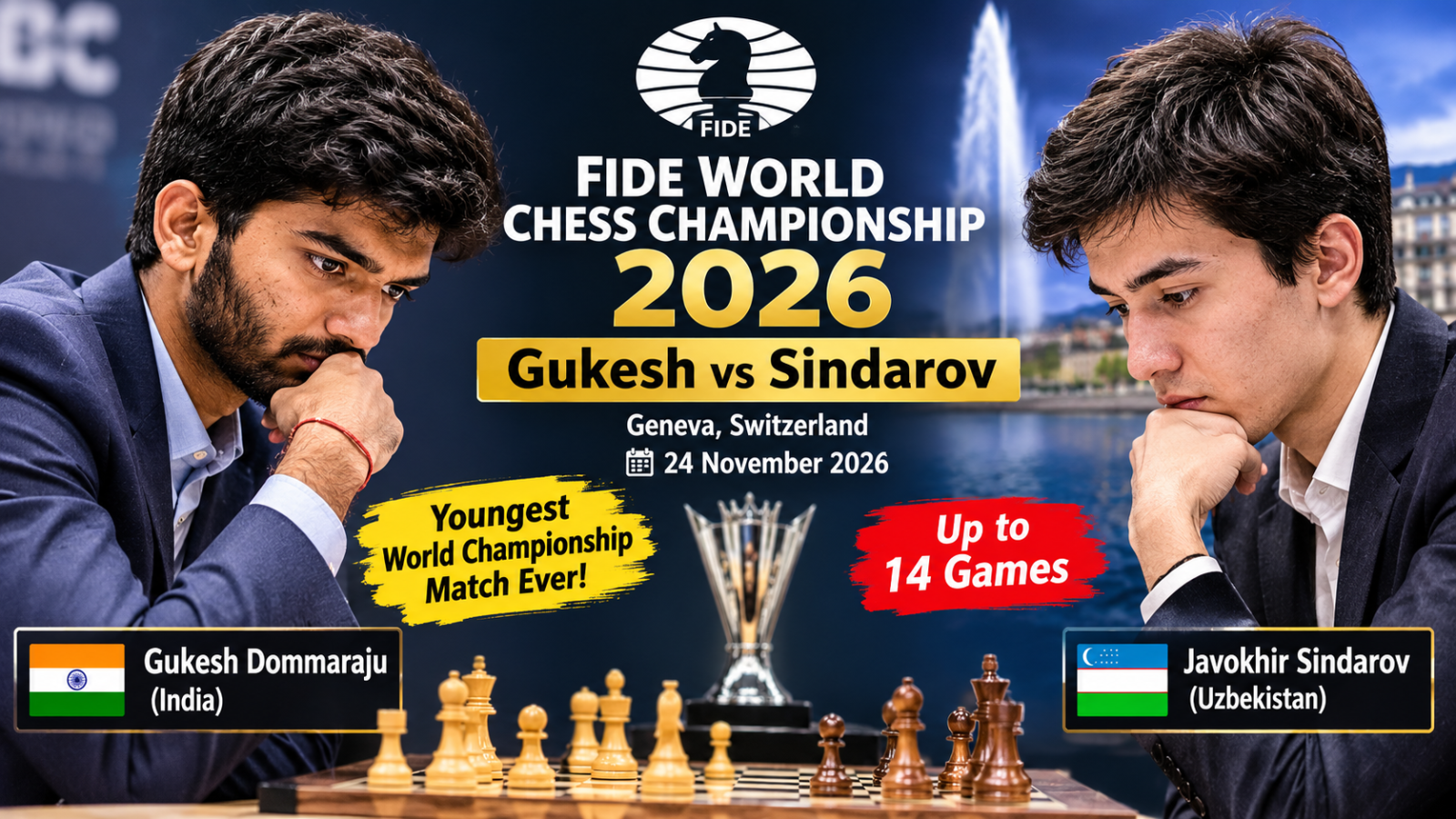
India's Gukesh Dommaraju will defend his world chess title against Uzbekistan's Javokhir Sindarov in Geneva, with Game 1 on 24 November 2026. Both players are 20, which makes it the youngest World Championship match in history. The format is up to 14 classical games, and the first player to 7.5 points becomes champion. On paper the challenger is the favourite: he is rated 72 points higher, leads their classical head-to-head and has had a far better year. Gukesh has the one thing Sindarov doesn't, which is the experience of winning one of these matches.
Last updated: 16 November 2026. Dates were changed once after the match was first announced, and broadcast and ticket details were still unconfirmed when we checked. Always confirm with FIDE's official channels.
Key Takeaways
- The match is in Geneva, Switzerland. Game 1 is on 24 November, and Game 14, if needed, is on 11 December. Tiebreaks, if needed, are on 12 December.
- Games start at 3 p.m. Geneva time, which is 7:30 p.m. in India, 9 a.m. US Eastern and 6 a.m. US Pacific.
- The prize fund is $2.5 million. Each player earns $200,000 for every classical game he wins.
- Sindarov won the 2025 World Cup and then the 2026 Candidates Tournament in Cyprus unbeaten, scoring 10 out of 14.
- Gukesh slipped below a 2700 rating at the Chess Olympiad in September for the first time in four years, though he remains a proven match player.
The dates changed, so check which ones you saw
When FIDE first announced Geneva as the host city, it said the match would run from 25 November to 15 December. Then the match regulations approved by the FIDE Council on 23 August brought the schedule forward: Game 1 a day earlier and the finish three days earlier. The schedule most reports now use is the revised one. If you bookmarked the first dates, they're out of date.
| Date | What happens |
|---|---|
| 20 November | Players arrive in Geneva. |
| 22 to 23 November | Opening ceremony, media days and technical meeting. |
| 24 to 26 November | Games 1 to 3. Rest day on 27 November. |
| 28 to 30 November | Games 4 to 6. Rest day on 1 December. |
| 2 to 4 December | Games 7 to 9. Rest day on 5 December. |
| 6 to 8 December | Games 10 to 12. Rest day on 9 December. |
| 10 to 11 December | Games 13 and 14 (if needed). |
| 12 December | Tiebreaks if the score is 7–7, then the closing ceremony. |
Why Geneva? Interim FIDE president Viswanathan Anand said the governing body wanted neutral ground, even though India, the United States and Cyprus had also shown interest. It's the first World Championship match in Switzerland since Kramnik and Leko played in Brissago in 2004.
How a 14-game match works
A win is worth one point, a draw half a point, and the first player to reach 7.5 wins the title on the spot. Do the math on the shortest possible match: seven wins and a single draw adds up to 7.5 points in eight games, so a match could in theory finish as early as Game 8 on 3 December. In practice that almost never happens, because top-level classical chess has a lot of draws. If both players are on 7 points after Game 14, the title is decided by faster tiebreak games on 12 December.
The time zones, for anyone planning to watch live:
| Place | Game start time |
|---|---|
| Geneva | 3:00 p.m. |
| India (IST) | 7:30 p.m. |
| US Eastern | 9:00 a.m. |
| US Pacific | 6:00 a.m. |
Where you can watch is less clear. FIDE hadn't announced broadcast arrangements in the most recent information we found. The 2024 match was streamed on FIDE's YouTube and Twitch channels with live commentary, so something similar is likely, but treat that as a guess until FIDE confirms.
Meet the challenger
Sindarov became a grandmaster at 12 and spent years looking like a prodigy who was about to break through. In 2025 he did. He won the FIDE World Cup in Goa, beating China's Wei Yi in the final, which earned him a place in the Candidates. In Cyprus this spring he went through the eight-player tournament without a single loss, scoring 10 out of 14 with six wins and eight draws, and clinched first place with a round to spare. Across his first four major classical events of 2026, he reportedly scored 14 wins, 29 draws and only two losses in 45 games.
He also won gold with Uzbekistan at the Chess Olympiad in Samarkand, going unbeaten there.
Meet the champion
Gukesh won the 2024 Candidates at 17 and then beat Ding Liren in Singapore in December 2024, 7.5 to 6.5, to become the youngest undisputed world champion at 18. This is his first title defence.
His 2026 hasn't matched that. At the Olympiad in Samarkand, where India took silver, he went into the final round on 8.5 out of 10 and then lost. During the event his live rating dropped below 2700, the first time in four years. The American Fabiano Caruana has cautioned against reading too much into this, saying Gukesh's ability doesn't vanish overnight and his form could turn quickly. That's fair. Match chess is a different animal from tournament chess.
The numbers
| Measure | Gukesh | Sindarov |
|---|---|---|
| Age at start | 20 | 20 |
| Rating | About 2710 | About 2782 |
| Classical head-to-head | 0 wins | 2 wins, 1 draw |
| 2026 rapid and blitz meetings | 1 win (rapid) | 2 wins (blitz) |
| World Championship match experience | Won one | None |
Their most recent classical game, at Tata Steel in January, was a draw. Sindarov's two classical wins came at the 2018 Moscow Open and the 2022 Sharjah Masters, long before either was a star.
What does a 72-point rating gap actually mean? Under the standard Elo formula, it implies the higher-rated player scores about 60% of the points in an average game. Over 14 games that's roughly 8.4 points, against the 7.5 needed to win. So Sindarov is the favourite, but a 60% edge is not a lock, especially since draws are common and one bad day can swing a match. That's a rough statistical estimate, not a forecast.
What the experts say
Magnus Carlsen has called Sindarov a significant favourite and said he has no obvious weaknesses, while adding that the psychology of a match can change the picture fast. Ian Nepomniachtchi also leans towards the challenger. Sindarov's friend and fellow Uzbek, Nodirbek Abdusattorov, who is helping him prepare, put his chances at 80–20, though he is obviously not a neutral voice. Sindarov himself has said he is preparing for the best version of Gukesh.
There's an old saying in chess that the champion in a match starts with an advantage the ratings can't see: he has done this before. Gukesh survived the pressure of 2024. Sindarov hasn't been tested like that yet.
Money and what happens if someone drops out
The prize fund is $2.5 million. Under the regulations, each player gets $200,000 for every classical game he wins, and the remainder is shared according to the rules. If the match goes to tiebreaks, the winner takes $1.3 million and the loser $1.2 million. If either player can't play, Anish Giri is first in line as a replacement and Fabiano Caruana is second.
Why it matters to readers in India and the US
For India, it's a chance for Gukesh to defend the title he won in 2024 and keep it in the country, after a remarkable decade for Indian chess. The rivalry also has a regional dimension, with Uzbekistan emerging as a chess power that took Olympiad gold on home soil. For US readers, the interest is more general: the youngest title match ever, a neutral Swiss venue and an American, Caruana, waiting in the wings. We covered two other global sporting stories in our guide to cricket at LA28 and in our report on the Dakar Youth Olympics.
What to watch for in the first week
- Game 1 colours. Who holds White first matters, since White has a small edge and the first game sets the tone.
- Draw rate. Plenty of classical games end level, and a string of early draws raises the stakes for the later ones.
- Preparation. Both players have trained with strong seconds, and surprise opening choices often decide games.
- Gukesh's nerves and energy, given a poor recent patch and a gruelling schedule.
- Broadcast and ticket announcements, which FIDE has yet to publish.
The Factora Take
This match is interesting precisely because the evidence points two ways. The ratings, the form and the experts all lean towards Sindarov. The champion's record in the one situation that counts leans the other way. A neutral reading is that Sindarov is the more likely winner, yet far from a sure one. Chess history is full of favourites who found that a 14-game match is its own sport. If you can stay up, or wake up early, watch Game 1: it will tell you a lot about whether Gukesh has rediscovered his form or is playing catch-up.
Frequently Asked Questions
When does the World Chess Championship 2026 start?
Game 1 is on 24 November 2026 in Geneva, at 3 p.m. local time, which is 7:30 p.m. in India.
Who is playing?
Defending champion Gukesh Dommaraju of India against challenger Javokhir Sindarov of Uzbekistan, the winner of the 2026 Candidates Tournament.
How does the match work?
Up to 14 classical games. The first player to reach 7.5 points wins. If the score is 7–7, tiebreaks are played on 12 December.
How much is the prize money?
The prize fund is $2.5 million, with $200,000 for each classical game won. If tiebreaks are needed, the winner gets $1.3 million and the loser $1.2 million.
Where can I watch it?
FIDE hadn't confirmed broadcast details when we checked. The 2024 match was streamed on FIDE's YouTube and Twitch channels, so look there first and follow FIDE's announcements.
Related articles