
The 436th Seat Challenge: How Two Delaware Voters Are Suing to Break the 1911 Congressional Cap
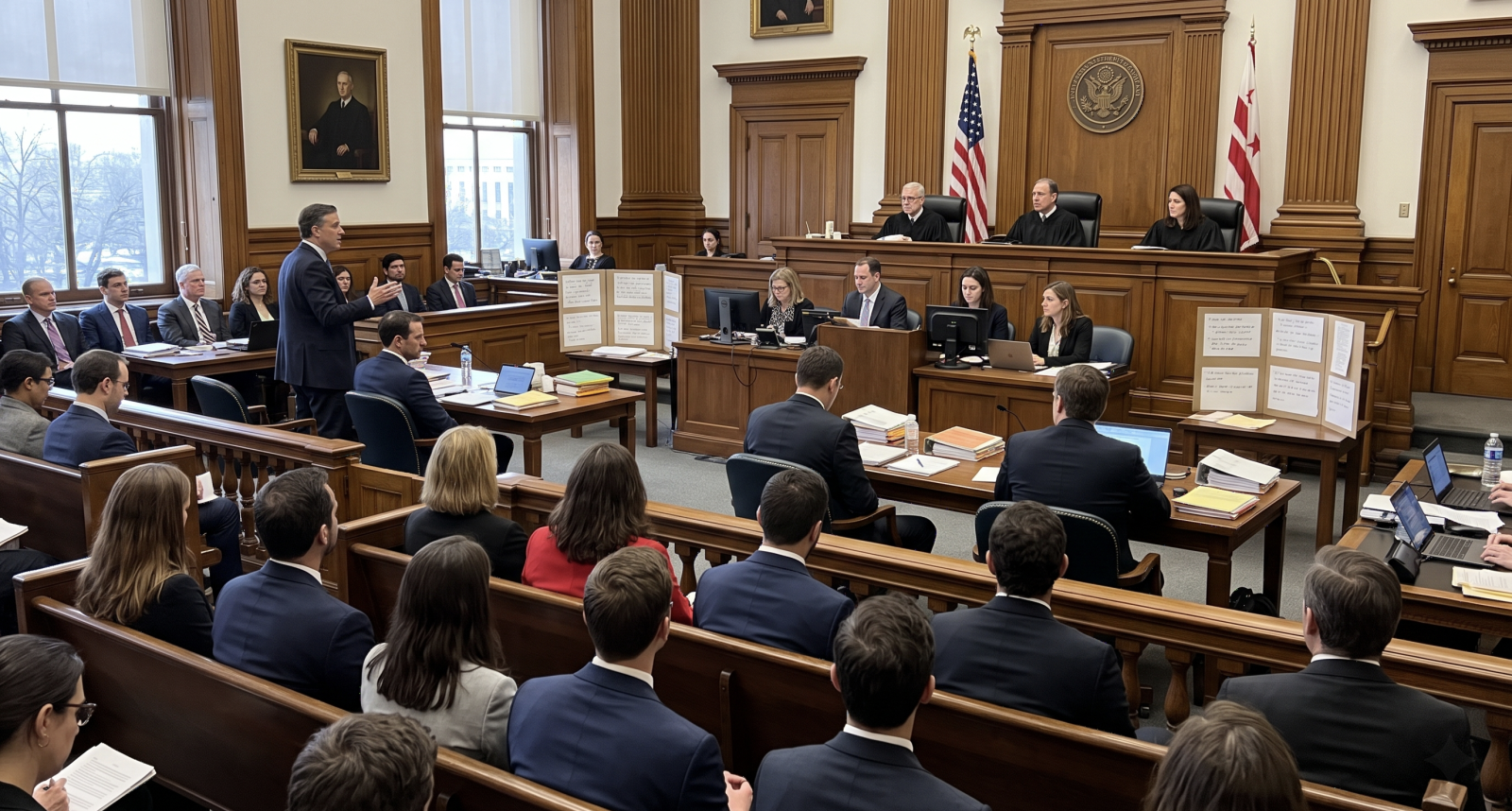
The 436th Seat Challenge: How Two Delaware Voters Are Suing to Break the 1911 Congressional Cap
While national political coverage remains overwhelmingly focused on post-midterm legislative battles, foreign policy crises, and executive appointments, a quiet yet profound constitutional challenge has been docketed in the U.S. District Court for the District of Columbia. Filed by two registered Delaware voters—political scientist David Redlawsk and resident Kevin Price—the federal lawsuit targets a century-old statutory mechanism that rarely enters mainstream conversation: the rigid 435-member cap on the United States House of Representatives.
The plaintiffs are asking a three-judge federal panel to declare the 435-seat ceiling unconstitutional and restore a second congressional district to Delaware—a seat the First State lost 203 years ago following the 1820 census reapportionment. If Congress refuses to act before a court-imposed deadline, the suit asks the judiciary to expand the lower chamber to 436 seats before the 2028 presidential election, an outcome that would simultaneously alter the nation's Electoral College arithmetic.
Beneath the immediate legal filing lies one of the most obscure, mathematically intricate, and consequential stories in American governance: how a legislative deadlock in the 1920s permanently froze the size of the "People’s House", creating severe representational distortions that leave some American citizens with nearly half the congressional voice of neighbors living in similarly sized states.
The 1911 Freeze and the Permanent Apportionment Act of 1929
For the first 120 years of American constitutional history, the House of Representatives was a dynamic, expanding institution. When the First Congress convened in 1789, the chamber consisted of just 65 members. As new states entered the Union and the domestic population surged, Congress routinely passed new apportionment laws every decade after the decennial census, adding seats so that fast-growing states could gain representation without forcing slower-growing states to surrender existing districts.
That tradition ended abruptly in the early twentieth century. Following the 1910 census—when the total United States population stood at roughly 92 million—Congress passed the Apportionment Act of 1911, establishing a chamber size of 433 members, with provisions to add one seat each for Arizona and New Mexico upon their admission to statehood in 1912. That brought the chamber to 435 seats.
Then came the 1920 census, which recorded a historic demographic shift: for the first time, more Americans lived in urban industrial centers than in rural agricultural communities. Fearing a massive transfer of political power from rural agrarian districts to rapidly growing northern and midwestern cities, rural lawmakers blocked every reapportionment bill throughout the 1920s. For an entire decade, Congress violated its constitutional mandate to reapportion seats after a census. By 1929, a single congressman in Detroit represented 1.3 million residents, while some rural districts in Missouri held fewer than 180,000 people.
To break the institutional paralysis, lawmakers passed the Permanent Apportionment Act of 1929. Rather than expanding the chamber to accommodate a growing country, Congress permanently locked the House at 435 seats and created an automatic mathematical formula to redistribute those fixed seats every ten years. Because the total number of seats could no longer grow, reapportionment became a zero-sum game: for one state to gain a representative, another state had to lose one.
The Delaware vs. Montana Anomaly: A Quantization Crisis
Because the U.S. Constitution requires every state to receive at least one representative regardless of population—and prohibits congressional districts from crossing state lines—the 435-seat ceiling creates sharp mathematical cliffs known to political mathematicians as "quantization errors". Nowhere is this distortion more visible today than in the stark comparison between Delaware and Montana.
According to the 2020 decennial census figures cited in the federal complaint, Delaware recorded a population of 990,837 residents, while Montana recorded 1,085,407 residents. Separated by fewer than 95,000 people—a population difference of less than 10 percent—Montana was awarded two congressional districts, whereas Delaware remained confined to a single at-large seat.
| Metric / Institutional Benchmark | Delaware (Current) | Montana (Current) | Delaware (Under 436-Seat Remedy) |
|---|---|---|---|
| 2020 Census Apportionment Population | 990,837 | 1,085,407 | 990,837 |
| U.S. House Representatives | 1 (At-Large) | 2 Districts | 2 Districts |
| Residents Per Representative | 990,837 | 542,704 | 495,419 |
| Electoral College Votes | 3 Votes | 4 Votes | 4 Votes |
| Variance vs. National Average (~761,169) | -23.2% representation per person | +40.3% representation per person | +53.6% representation per person |
The legal filing highlights that Delaware’s single representative serves the largest number of constituents of any House member in the nation. Under the current allocation, Delaware voters receive 23.2 percent less representation per person than the national average, and barely half the legislative representation afforded to residents of Montana. More recent Census Bureau population estimates through mid-2025 indicate Delaware has grown to nearly 1.06 million people—outpacing Montana’s growth rate—yet the state remains locked out of a second seat until at least the 2030 census cycle.
Inside the Huntington-Hill Formula: How Math Decides Political Power
Since 1941, the U.S. Census Bureau has distributed seats among the 50 states using a specialized algorithm known as the Method of Equal Proportions, or the Huntington-Hill method. Developed by Harvard mathematician Edward Vermilye Huntington and Census Bureau statistician Joseph Adna Hill, the formula was designed to minimize the relative percentage difference in district populations between any two states.
Under this mechanism, every state automatically receives its first 50 seats. The remaining 385 seats are assigned one by one based on a priority value calculated by dividing a state's population (P) by the geometric mean of its current number of seats (n) and its next potential seat (n + 1):
When a state holds n = 1 seat, the denominator is √(1 × 2) = √2 ≈ 1.4142. Consequently, for a single-district state to win a second seat, its population divided by 1.4142 must rank higher than the priority values of larger states competing for their 10th, 20th, or 50th seats. In the 2020 apportionment calculation, Montana captured the 435th and final seat with a priority score just ahead of New York—which famously lost a congressional seat by a margin of just 89 residents—leaving Delaware several slots below the cutoff threshold.
Why the 1992 Supreme Court Precedent Stands in the Way
Legal scholars tracking the District of Columbia lawsuit point out that Redlawsk and Price face a formidable constitutional hurdle established more than three decades ago. In 1992, the state of Montana found itself on the opposite side of the exact same mathematical cliff. Following the 1990 census, Montana's population of roughly 803,000 caused it to drop from two congressional districts to one, leaving it with a single district of more than 800,000 people while the national average hovered near 572,000.
Montana sued the federal government in United States Department of Commerce v. Montana, arguing that the 435-seat cap and the Huntington-Hill formula violated Article I, Section 2 of the Constitution and the "one person, one vote" principle established in Wesberry v. Sanders.
In a unanimous 9–0 decision authored by Justice John Paul Stevens, the U.S. Supreme Court rejected Montana's challenge. The Court ruled that while intra-state congressional districts drawn by state legislatures must achieve near-exact population equality, the constitutional requirement that seats be apportioned "among the several States" inevitably involves indivisible whole numbers. Because fractions of a representative cannot be assigned and districts cannot cross state borders, the Supreme Court held that Congress enjoys broad discretion to choose both the size of the House and the mathematical formula used to allocate seats.
To overcome Department of Commerce v. Montana, the Delaware plaintiffs—who named Commerce Secretary Howard Lutnick, acting Census Bureau head George Cook, and House Clerk Kevin McCumber as defendants—are arguing that modern demographic growth has stretched the 1911 cap far beyond what the Framers or the 1992 Court contemplated. When the Constitution was ratified, James Madison proposed an original First Amendment—never ratified, though still technically pending before the states—that would have capped district sizes at 50,000 residents. Today, the average House member represents over 760,000 constituents, making the U.S. House of Representatives the second-most populous lower legislative chamber per representative in the democratic world, trailing only India’s Lok Sabha.
The Electoral College Ripple Effect and What Happens Next
Beyond legislative representation on Capitol Hill, adding a 436th seat carries direct consequences for presidential elections. Under the Twelfth Amendment and Article II of the Constitution, each state's Electoral College vote total equals the sum of its U.S. Senators (always two) plus its U.S. House members. Adding a second House seat for Delaware would increase the state's electoral votes from three to four, expanding the total Electoral College from 538 to 539 electors.
Interestingly, expanding the Electoral College to an odd number—539—would mathematically eliminate the possibility of a 269–269 Electoral College tie in presidential elections, provided no faithless electors abstain. Conversely, inside the House of Representatives, an even-numbered chamber of 436 voting members would theoretically introduce the possibility of 218–218 tied floor votes on legislation or Speaker elections when all members are present.
Furthermore, redistricting analysts note an intriguing constitutional quirk in the plaintiffs' requested remedy: if a court were to strike down the 435-seat limit and simply add a 436th seat under existing Huntington-Hill priority rankings, that 436th seat would mathematically belong to New York, not Delaware, because New York stood next in line on the 2020 priority list. To award Delaware a second district under the Huntington-Hill formula, Congress would actually have to expand the House to roughly 473 members—a dramatic structural expansion that lawmakers on both sides of the aisle have resisted for nearly a century.
As the three-judge panel in Washington weighs the government's upcoming motion to dismiss, the Delaware lawsuit revives a foundational question of American democracy: whether a legislative chamber capped when the nation had 92 million people and 46 states can adequately represent a republic of more than 340 million citizens.
Related articles