Mali's Fuel Blockade, 14 Months On: What Is Happening in Bamako
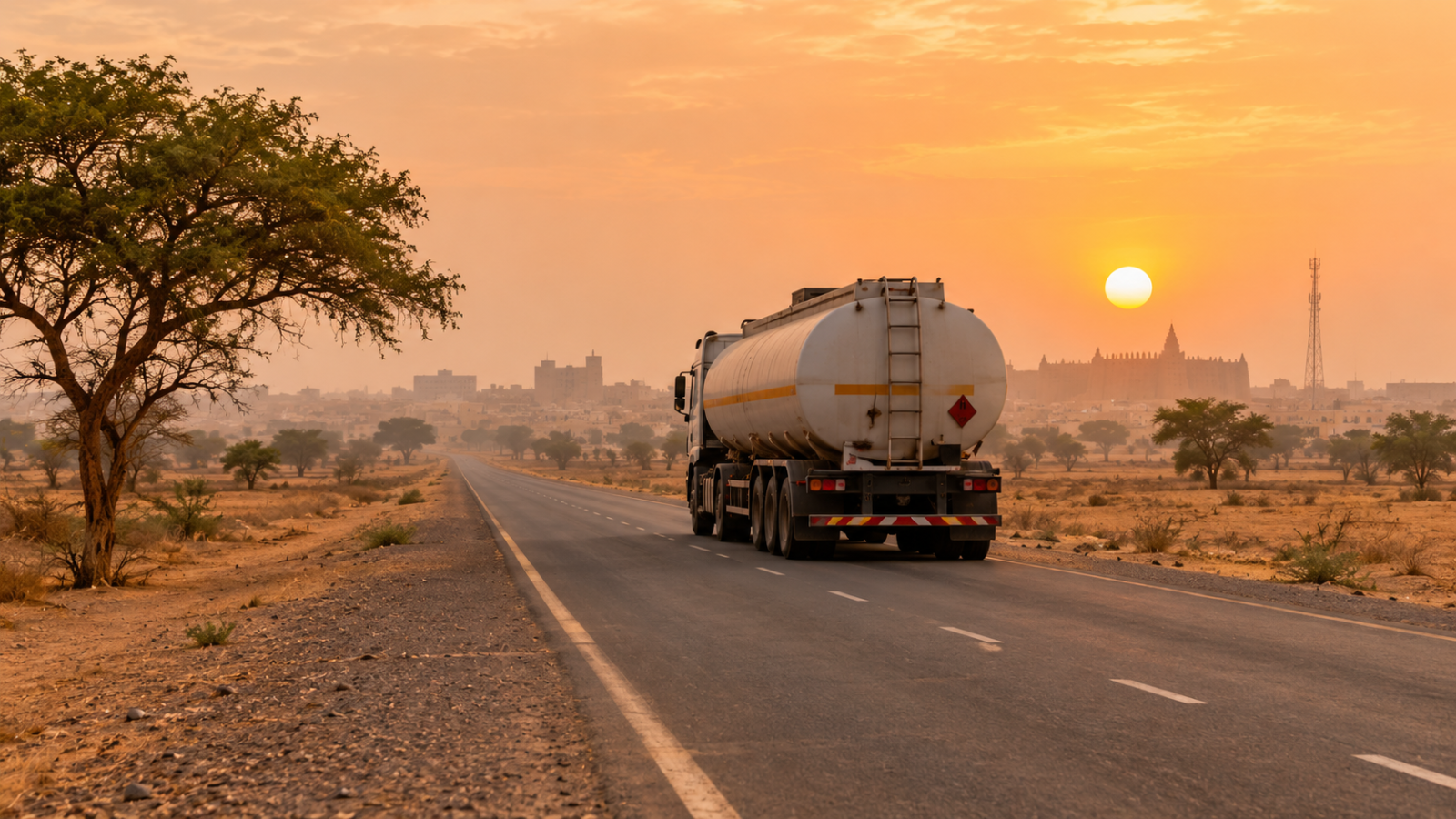
For more than a year, the fight for Mali has been about gasoline. Since September 2025, an al-Qaeda-linked group called JNIM has been burning and blocking fuel tankers headed for the landlocked country, and the military government has answered with huge convoys under armed escort. Bamako, a city of roughly four million people, is not under full siege and it is not back to normal either. The ruling junta still holds the capital. The blockade has eased at times, but it has not ended, and the war around it has grown far beyond fuel.
Last updated: 13 November 2026. The security situation in Mali changes quickly, and information from the ground is hard to confirm. Treat every figure below as an estimate.
Key Takeaways
- JNIM announced its fuel blockade on 3 September 2025. It has now lasted about 14 months.
- In April 2026, JNIM and the Tuareg-led Azawad Liberation Front (FLA) launched coordinated attacks, and the defence minister was reported killed.
- Government forces and Russia's Africa Corps retook the northern town of Kidal on 6 October 2026.
- Fuel is reaching Bamako again, but only in escorted convoys of several hundred tankers at a time. Reporting from Bamako notes that armed groups can still cut key routes.
- Analysts disagree sharply on whether the junta is close to collapse or simply under heavy pressure.
Why Fuel? Why Mali?
Look at a map and the strategy becomes obvious. Mali has no coastline. Almost every litre of petrol and diesel it burns arrives by road from ports in Senegal and Côte d'Ivoire, along highways that run through country where the army is thin on the ground. If you want to squeeze a government and you don't have the strength to storm its capital, you don't need to. A burning tanker on a rural road does the job at a fraction of the price.
That is what JNIM did. A spokesman announced the blockade on video on 3 September 2025, and tankers began to burn. Estimates of how many were destroyed range from around 200 to more than 300, depending on who is counting and when. Some tankers were escorted by soldiers. Some burned anyway.
What It Actually Felt Like
Numbers hide the daily texture of a crisis like this. In Bamako, people spent hours in queues at filling stations. Power cuts got worse, because the grid leans on fuel-fired generation. Farm machinery stopped in the middle of harvest. Mines in the west, which depend on diesel generators and are one of the state's most important sources of revenue, felt it too. A medical charity warned that fuel shortages were hurting its work.
In late October 2025 the government shut schools for two weeks, and they reopened on 10 November. Around the same time, the United States and several European countries told their citizens to leave. When a convoy of a couple of hundred tankers finally made it into the capital, residents reportedly cheered. That tells you how bad the shortage had become: people clapping for a line of trucks.
Fourteen Months, Briefly
| When | What happened |
|---|---|
| 3 September 2025 | JNIM announces the fuel blockade. |
| Late Oct to 10 Nov 2025 | Schools closed. Foreign governments urge citizens to leave. On 1 November JNIM says it will also target fuel trucks entering from Niger. |
| April 2026 | JNIM and the FLA attack sites in Bamako, Kati, Mopti, Gao and Kidal. Kidal falls to the FLA. JNIM declares a blockade on roads into Bamako. |
| 1 May 2026 | An escorted convoy of more than 800 tankers reaches Bamako, according to Russia's Africa Corps. |
| 10 September 2026 | JNIM attacks an army camp at Dioura in central Mali. |
| 14 September 2026 | The government says more than 900 tankers entered Bamako under military escort. |
| 5 to 6 October 2026 | The FLA withdraws from Kidal and government forces retake it without a fight. |
April: When It Stopped Being Only About Fuel
The spring offensive changed the nature of the conflict. JNIM and the FLA are not natural partners. JNIM is a jihadist network with an al-Qaeda link. The FLA is a Tuareg-led movement that wants autonomy or independence for the north. But in April they hit the state at the same time in several places, and the Malian army, stretched across a country almost twice the size of Texas, struggled to respond.
The results were serious. Kidal, a symbolic northern town the government had held for about two years, fell, and Russia's Africa Corps pulled out of Kidal and Tessalit. The defence minister, Sadio Camara, was reported killed in the attacks, and the head of the junta, Assimi Goïta, took the defence portfolio himself. That detail matters, because Camara had been a central figure in Mali's turn from France toward Russia.
Russia's role is worth a short pause. Africa Corps, the successor to the Wagner Group, has roughly 1,500 to 2,500 personnel in Mali by various estimates. It was brought in to help the junta, and it has escorted fuel convoys and provided air power. It has also been accused by human rights groups of abuses against civilians, which has fed resentment in some communities. JNIM, for its part, has been accused of killing civilians.
Where Things Stand Now
The picture is mixed, and anyone who gives you a one-line summary is probably selling something.
The good news for the junta: it retook Kidal on 6 October. It also seems to have patched up relations with Algeria, which borders the north and matters a great deal to the FLA. Fuel is moving into Bamako in escorted convoys, and the capital has not fallen.
The bad news: analysts at the Soufan Center describe Kidal as a moderate gain with limited strategic value, partly because the FLA called its retreat "temporary" and JNIM has simply shifted its attention elsewhere. JNIM kept claiming attacks on patrols and pro-government militias in central regions through October. The government's own account of the convoys quietly admits the problem: if you need heavy military escorts to move fuel, the roads are not safe.
Two Ways to Read the Same Facts
The "pressure, not collapse" view. Some analysts argue that scary headlines about an imminent fall of Bamako have been wrong for more than a year. The capital still functions, convoys get through, and JNIM has not tried to storm the city. On this reading, the blockade is a tool to force the government to the negotiating table, not a prelude to a takeover. The junta itself says the situation is under control.
The "fragile regime" view. Others say the state's grip is thinner than it looks. It depends on Russian escorts. It has lost and regained northern towns within months. And fuel that can be cut off by a few ambushes is a weakness that can be used again. Analysts have warned that a sudden shock, such as a mutiny or a serious military defeat, could change things fast, as happened in 2012.
Both camps have evidence. Neither can prove what happens next. If you want a rough test of who is right, watch whether the convoys keep getting through without major losses.
Why Readers in the US and India Should Care
Mali can feel distant, but three threads connect it to everyone else. First, energy: the same fuel-chokepoint logic applies to any import-dependent country, which is why our piece on why fuel prices stay high after Hormuz partly reopened is a useful companion. Second, security: if an al-Qaeda affiliate ever governed a country, as some analysts have warned, the consequences would reach well beyond West Africa. Most experts consider that outcome unlikely for now, but it explains the attention of foreign governments. Third, great-power competition: Russia has staked a lot on Mali, and its performance there is being watched across Africa.
It is also one of several African crises getting little coverage. Our report on the Ebola outbreak in Congo is another.
How to Read Mali Headlines Without Being Fooled
- Check the date. Many "Bamako about to fall" articles date from late 2025 and are often recycled.
- Ask who is speaking. The junta, JNIM, Africa Corps and the FLA each have reasons to exaggerate or hide losses.
- Separate claims from confirmation. Casualty figures vary by thousands depending on the source. Treat them as claims.
- Watch the roads, not the rhetoric. Convoy arrivals, fuel prices and school openings tell you more than statements.
- Be careful with travel. If you or your employer have any link to Mali, rely on your government's current travel advisory, not social media.
What to Watch Next
Four things will shape the next few months. Can the army keep large convoys moving without heavy losses? Does JNIM go after power plants or fuel depots instead of tankers? Do the junta and Algeria deepen their understanding, and does it hurt the FLA? And does anything shake the unity of the armed forces? Any of these could change the picture quickly.
The Factora Take
The most useful thing to say about Mali right now is also the least dramatic: this is a state under strain, not a state in free fall, and the difference is easy to lose. A year of blockade has done real damage to daily life, to the economy and to the army's morale, and the spring offensive showed how quickly things can slip. But the capital is still standing, and the government has found ways to keep fuel flowing. Whether that is a durable fix or a stopgap is the open question. We would be wary of anyone, on either side, who claims certainty. For people outside Mali, the practical lesson is simpler: wars today are fought as much over roads, power and logistics as over territory, and the world tends to notice only when a capital goes dark.
Frequently Asked Questions
What is JNIM?
JNIM, short for Jama'at Nusrat al-Islam wal-Muslimin, is an armed group affiliated with al-Qaeda that operates in Mali and elsewhere in the Sahel. It announced the fuel blockade in September 2025.
Is Bamako under siege?
Not completely. JNIM has declared a blockade on roads into the capital and has cut routes, but the government still controls Bamako and brings in fuel under armed escort. Analysts disagree on how fragile the situation is.
Who is the Azawad Liberation Front?
The FLA is a Tuareg-led movement in northern Mali that seeks greater autonomy or independence. It coordinated with JNIM in the April 2026 offensive, although their long-term goals differ.
Did the government retake Kidal?
Yes. Government forces, backed by Russia's Africa Corps and allied Tuareg groups, retook Kidal on 6 October 2026, after the FLA announced a withdrawal it called temporary.
Why is Russia involved in Mali?
After the junta expelled French forces and a large UN peacekeeping mission, it turned to Russia. Russia's Africa Corps, the successor to the Wagner Group, now supports the government with escorts, air power and security for the ruling leadership.
Related articles