
Earth Captures a Temporary ‘Mini-Moon’: The Bizarre Orbit of Asteroid 2026 QQ8 Explained
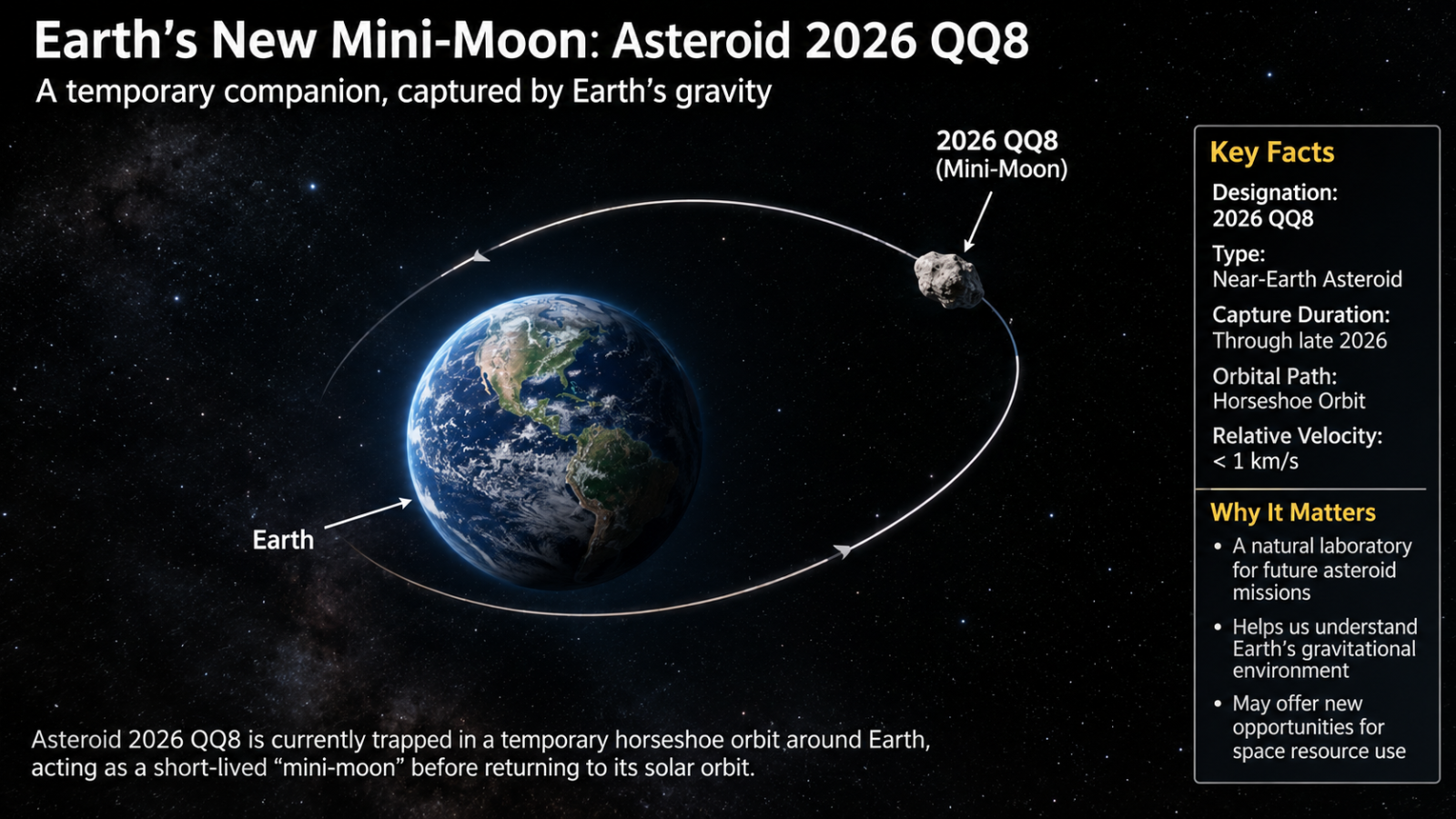
Skywatchers and planetary scientists have confirmed that Earth is currently accompanied by a temporary secondary natural satellite—a phenomenon colloquially known as a "mini-moon." Designated by the Minor Planet Center as asteroid 2026 QQ8, the celestial body was snared by Earth's gravitational pull and pulled into an eccentric, looping orbital trajectory rather than continuing along its solar orbit.
While the moon remains Earth's sole permanent natural satellite, gravitational physics periodically allows near-Earth objects traveling at precise speeds to enter short-term horseshoe orbits, acting as temporary celestial escorts before escaping back into deep interplanetary space.
Trajectory and Detection: How 2026 QQ8 Was Discovered
The small near-Earth object was tracked using deep-sky observation instruments, including the University of Hawaii’s 2.2-meter telescope and the Lowell Discovery Telescope. Follow-up photometric analysis resolved initial ambiguities, confirming that the body is natural stony-iron debris rather than discarded human space hardware, such as spent rocket boosters.
Key astrophysical characteristics of the encounter include:
- Unusual Loop Dynamic: Instead of following a circular or standard elliptical orbit, 2026 QQ8 traces an open horseshoe path, weaving closely through the Earth-Moon gravitational barycenter.
- Low Relative Velocity: For a planetary body to capture an asteroid without causing an impact, the incoming object must match Earth's orbital speed nearly identically—typically within a narrow delta of under 1 km per second.
- Temporary Capture Window: Orbital simulations show the asteroid will remain gravitationally bound only through late 2026 before Earth's gravity slingshots it back into an independent heliocentric orbit around the Sun.
The Science of Mini-Moons: Why Do They Happen?
Mini-moons are categorized into two primary astronomical classes: temporarily captured orbiters (which complete one or more full orbits around the planet) and temporarily captured flybys (which loop briefly inside the planet's gravitational sphere of influence without completing a closed circle).
Earth's gravitational neighborhood is continuously crossed by the Apollo and Aten asteroid groups. Under specific alignment geometries, Earth's gravity acts as a delicate brake, decelerating the projectile just enough to lock it into an open orbital dance. Previous verified visitors of this type include asteroids 2020 CD3 and 2024 PT5, alongside quasi-satellites that appear to shadow Earth from outside its formal gravitational boundary.
Future Asteroid Mining and Deep-Space Exploration
While 2026 QQ8 poses zero impact risk to the planet, temporary natural satellites have become primary targets of interest for space agencies and commercial exploration entities. Because mini-moons travel at low relative velocities compared to deep-space asteroids, they represent ideal proving grounds for future sample-return missions and autonomous orbital mining tests.
Deploying robotic probes to study a mini-moon requires significantly less propulsion fuel than reaching the main asteroid belt between Mars and Jupiter. Scientists anticipate that next-generation sky survey telescopes will identify dozens of additional short-term companion objects over the coming decade, transforming temporary visitors into accessible laboratories for understanding the early solar system.
Related articles