
India's Data Privacy Law, One Year In: What Changes Now and in 2027
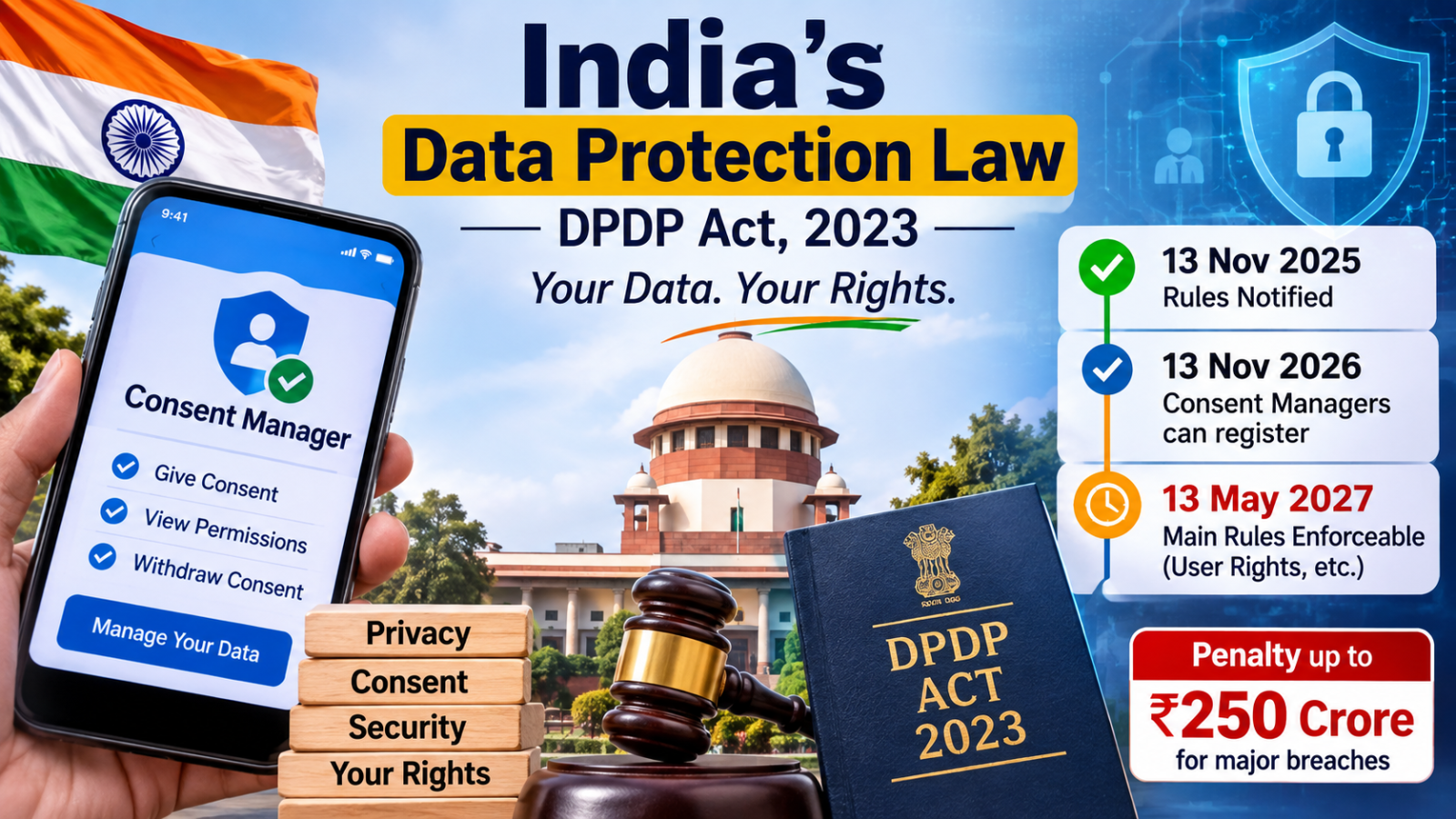
India's data protection rules turned one year old on 13 November 2026, and a new piece of the system switched on that day: companies can now apply to register as "Consent Managers", services that let you give, check and withdraw permission for your data in one place. Most of the law's real obligations, however, don't start until 13 May 2027. In between, the regulator that is supposed to enforce it hasn't been fully staffed, and the Supreme Court is hearing a challenge from news publishers. If you run a business, you have about six months. If you're an ordinary user, your rights are coming, but not yet.
Last updated: 15 November 2026. The law's rollout is phased and partly contested in court. Dates and details could change. This article is general information, not legal advice.
Key Takeaways
- The Digital Personal Data Protection (DPDP) Rules, 2025 were notified on 13 November 2025 and run on a three-stage timetable.
- Stage two began on 13 November 2026: Rule 4, on registering Consent Managers.
- Stage three, on 13 May 2027, is when notices, consent, user rights, breach reporting and children's data duties become enforceable.
- Penalties can reach ₹250 crore for failing to protect data with reasonable security safeguards.
- On 27 October 2026, a Supreme Court bench led by the Chief Justice issued notice to the Union Government on a challenge by news publishers. No stay has been reported.
The three-step timetable
| Date | What starts |
|---|---|
| 13 November 2025 | Definitions, and the rules that set up the Data Protection Board. |
| 13 November 2026 | Rule 4: Consent Managers can register with the Board. |
| 13 May 2027 | Main duties for businesses (Data Fiduciaries), user rights, breach reporting, children's data, and penalties. |
Some advisers have noted that officials floated shortening the 18-month runway at a consultation in January 2026. Nothing was formally notified, so 13 May 2027 remains the operative date, as far as we can find.
What a Consent Manager actually is
Think of it as a remote control for your permissions. At the moment, each app or website asks for your consent separately, and good luck remembering what you agreed to in 2022. A Consent Manager is a registered, India-based intermediary that gives you one dashboard to grant, review and withdraw consent across many companies.
The law lets such firms register with the Data Protection Board from 13 November 2026. Here's the catch: according to reports, the Board has still not been fully staffed. MeitY invited applications for its members in May 2026, and as of September no chairperson or members had been reported appointed. A parliamentary reply in August and a later RTI response, as described in one analysis, point the same way. So the registration window is open on paper, but the body that has to approve applications may not be ready. That doesn't change the law, but it does make the practical start uncertain.
What you'll be able to do from May 2027
The Act calls individuals "Data Principals". From May 2027, they get a set of rights over their digital personal data:
- Ask for a summary of the data a company holds about them and how it's used.
- Ask for corrections and for erasure.
- Use a grievance process with the company before escalating to the Board.
- Nominate someone to exercise their rights if they die or can't act.
- Withdraw consent as easily as they gave it.
Companies, in turn, will have to give clear notices, collect consent for specific purposes, keep data secure, report breaches and delete data when it's no longer needed. Large platforms reportedly face rules on deleting data after a period of inactivity.
Children's data: the strictest part
The law treats anyone under 18 as a child. Before processing a child's data, a company must get verifiable consent from a parent or guardian. It is also barred from tracking children, monitoring their behaviour or targeting advertising at them. There are limited exemptions, for example for some healthcare and educational uses under the Rules. For schools, ed-tech firms, gaming apps and social platforms, this will be the hardest part to build, because they will have to work out who is a child and who the parent is without collecting even more data than they should.
What happens if a company fails
| Failure | Maximum penalty |
|---|---|
| Not keeping reasonable security safeguards | Up to ₹250 crore |
| Not reporting a data breach | Up to ₹200 crore |
| Breaking the rules on children's data | Up to ₹200 crore (one source lists ₹150 crore) |
| Other breaches of the Act or Rules | Up to ₹50 crore |
| A user breaking their own duties (for example, false complaints) | Up to ₹10,000 |
These are ceilings, not automatic fines. The Board decides after an inquiry. One guide converts the top figure to roughly $30 million, which is a large sum for a typical Indian company.
On breaches, the Rules describe a two-step duty: tell the affected people and the Board promptly, then file a detailed report within 72 hours. Check Rule 7 for the exact wording, since summaries differ on which step carries the 72-hour deadline.
The court challenge and the RTI argument
On 27 October 2026, a Supreme Court bench headed by Chief Justice Surya Kant issued notice to the Union Government on a petition filed by a group of 21 news publishers. They challenge several provisions of the Act and the 2025 Rules, arguing, in the words of one report, that the framework sits at the centre of a debate over privacy, press freedom and State power. No interim stay has been reported, so the timetable still stands.
A separate dispute concerns Section 44(3), which amends the Right to Information Act by removing a proviso that used to let the public-interest test apply to personal information. Several petitions are pending. Defenders of the Act say India now has its first comprehensive privacy framework, built on a Supreme Court ruling that recognised privacy as a fundamental right. Critics, including press groups and transparency advocates, argue that parts of the law weaken journalism and public accountability. Both sides are making serious arguments, and the court hasn't ruled.
Who's covered, including foreign firms
The law applies to digital personal data, and to non-digital data that is later digitised. It also generally reaches companies outside India that process data in connection with offering goods or services to people in India. That matters for US and other foreign firms with Indian users, from app makers to online retailers. The government can also restrict transfers of data to specified countries, so cross-border businesses should watch for notifications.
What to do now
If you run a business. Six months is not much. Here's a sensible order.
- Map your data. List what personal data you collect, why, where it's stored and who gets it, including vendors.
- Rewrite your privacy notice in plain language, listing the purposes for each piece of data.
- Build a consent record you can produce on request, and a simple way to withdraw it.
- Draft a breach plan with named people and a 72-hour clock.
- Check whether you handle children's data and, if so, how you'll verify a parent.
- Review vendor contracts. You stay responsible for processors who handle data on your behalf.
- Set a retention schedule so you can delete data you no longer need.
If you're an ordinary user. Nothing changes on your phone tomorrow. But you can start reading what apps ask for, saying no to permissions they don't need, and being careful with your phone number, Aadhaar details and photos. Fraudsters already exploit leaked data, which is why our guide to UPI scams and digital arrest fraud is worth a read.
What to watch next
- Board appointments: whether a chairperson and members are named, and when the Board starts hearing applications.
- Consent Manager applications: which firms apply and whether any are approved before May.
- The Supreme Court case: the Union's reply and any interim orders.
- Any change to the May 2027 date, since a shorter or longer runway would shift everything.
- Sector guidance from regulators for banks, health and education.
The Factora Take
India is a year into building a privacy regime and the machinery still isn't finished. The rules are written, the penalties are large, and the clock is ticking, yet the referee isn't fully in place and a big court case is pending. That mismatch is the real story. For companies, the safe move is to treat 13 May 2027 as real and prepare now, because waiting for clarity may mean arriving late. For everyone else, the most useful thing is to keep an eye on whether the system can actually deliver the rights it promises. A privacy law is only as good as its enforcement, and that is the part nobody can judge yet.
This article is for general information only. It is not legal advice. Consult a qualified lawyer about your obligations under the DPDP Act and Rules.
Frequently Asked Questions
What is the DPDP Act?
India's Digital Personal Data Protection Act, 2023, supported by the DPDP Rules, 2025, sets rules for how businesses and the government handle people's digital personal data. It gives individuals rights and creates a Data Protection Board to enforce it.
When do the main obligations start?
13 May 2027, eighteen months after the Rules were notified. A smaller piece, Consent Manager registration, began on 13 November 2026.
What is a Consent Manager?
A registered intermediary that lets you give, review and withdraw consent across many companies from one platform.
How big are the penalties?
Up to ₹250 crore for failing to maintain reasonable security safeguards, and up to ₹200 crore for failing to report a breach. They are maximums set after an inquiry by the Board.
Is the law being challenged in court?
Yes. On 27 October 2026 the Supreme Court issued notice to the Union Government on a petition by news publishers, and other petitions on the RTI amendment are pending. No stay has been reported.
Related articles