Android Developer Verification: What It Means for Sideloading
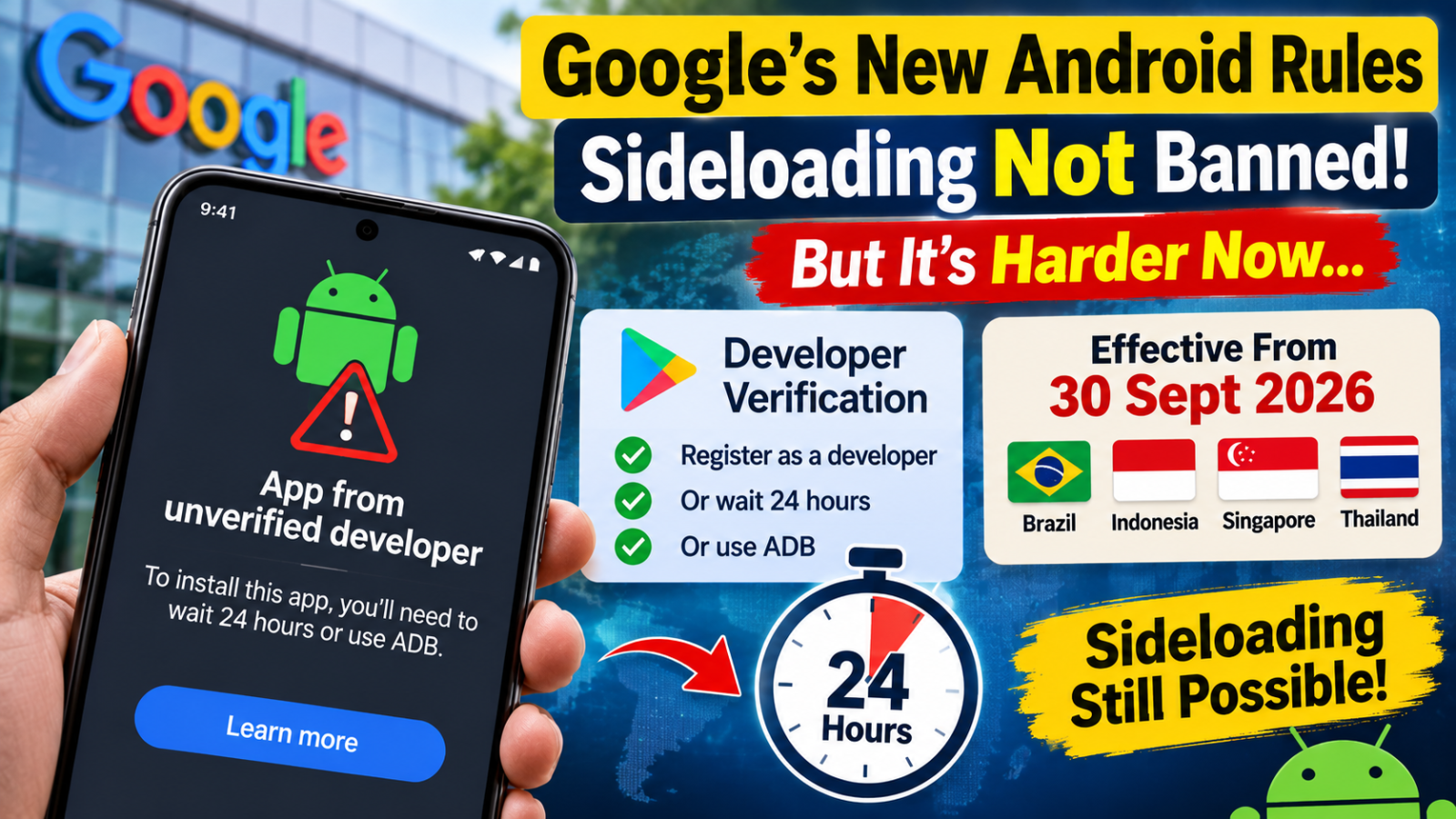
Google has not banned sideloading on Android, but it has made it harder. Since 30 September 2026, apps from developers who haven't verified their identity can't be installed in the normal way on certified Android phones in Brazil, Indonesia, Singapore and Thailand. In those countries, you now have to use an "advanced flow" that includes a 24-hour wait, or a developer tool called ADB. Google says it will extend the requirement worldwide in 2027, without giving a single date. If you live in the US or India, nothing has changed on your phone yet, but it likely will.
Last updated: 16 November 2026. The rollout is staged and reports differ on some details. Check Google's developer verification pages and your own device settings for what applies to you.
Key Takeaways
- Developer verification means an app must be linked to a developer whose identity Google has checked, even if you install it from a website or a third-party store.
- Enforcement began on 30 September 2026 in four countries, at seven participating app stores. A global rollout is planned for 2027.
- Unverified apps can still be installed, using the advanced flow or ADB. The advanced flow takes at least 24 hours.
- Google says the aim is to stop repeat malware developers. Critics, including F-Droid and more than 60 organisations, say it hands Google too much control.
- Hobbyists and students can get free "limited distribution" accounts, so they don't need a full verification.
What "developer verification" actually is
Until now, Android has worked on a simple principle. You can install an app from Google Play, from another store, or straight from a downloaded file (an APK), and the phone doesn't ask who made it. The APK route is called sideloading.
Under Google's new programme, every app installed on a certified Android device has to be registered by a verified developer. That means the developer proves who they are to Google, and registers the app's package name. Google announced the plan on 25 August 2025 and the rule applies whether an app comes from Play, a rival store or a file you downloaded yourself. "Certified" means the phone runs Google Play services and has passed Google's compatibility checks, which includes most Android phones that ship with Google's apps.
The company's argument is straightforward. At the moment, if a developer is caught spreading malware, Google can remove them from Play, but they can come back the next day under a new name. Tying distribution to a real-world identity is meant to make that harder.
The timeline so far
| When | What happened |
|---|---|
| 25 August 2025 | Google announces mandatory developer verification. |
| October to November 2025 | The "Keep Android Open" campaign forms. Google promises an advanced flow for experienced users and free accounts for students and hobbyists. |
| 24 February 2026 | An open letter urges Google to withdraw the requirement. More than 60 organisations from over 20 countries eventually sign it. |
| March 2026 | Verification opens to all developers on Play Console and the new Android Developer Console. |
| April to June 2026 | An "Android Developer Verifier" appears in Google system services settings. Early access to limited distribution accounts begins. |
| August 2026 | Google's plan says the advanced flow and limited accounts launch globally. |
| 30 September 2026 | Enforcement starts for seven stores in Brazil, Indonesia, Singapore and Thailand. |
| 2027 and beyond | Planned global rollout. No exact date announced. |
What the "advanced flow" really involves
This is the part that matters most if you like installing apps from outside the Play Store. According to Google's description and published summaries, an experienced user who wants to install an unverified app has to:
- Turn on developer mode in the phone's settings.
- Confirm that no one is pressuring them to install the app.
- Restart the phone.
- Wait 24 hours.
- Come back and authenticate with a fingerprint, face or PIN.
Google designed that wait to defeat a particular kind of scam, where a fraudster stays on the phone with a victim and walks them through installing a malicious app within minutes. A delay of a day breaks the pressure. It's an argument with real merit.
But look at it from the other side. If you're a developer or an enthusiast who installs a test build several times a week, a one-day wait is a major nuisance. For people like that, Google says the ADB route, a command-line tool, is unchanged. Reports differ on how widely the advanced flow was available outside the four launch countries after August, so check Settings on your own phone rather than assuming.
What it means for you, by country
| Where you are | What changes now | What to expect |
|---|---|---|
| Brazil, Indonesia, Singapore, Thailand | Apps from unverified developers need the advanced flow or ADB on certified devices running Android 7 or later. | Rules already live at participating stores. |
| United States | Little or nothing yet. | Planned for the 2027 global expansion. |
| India | Little or nothing yet. | Planned for the 2027 global expansion. No India-specific date announced. |
Indian readers should pay attention anyway, because sideloading is part of how many people use their phones, from sharing APKs of regional-language apps to testing tools from small developers. Commentators argue that small regional developers could be hit hardest if they don't want to register. That is their prediction, not an established fact.
Google's case, and the critics' case
Google's case. The company says verification adds accountability and cuts the supply of malicious apps. It has cited internal research saying sideloaded apps from internet sources contain more than 50 times as much malware as apps on Google Play. A later statement reportedly raised the multiple to 90. Google also stresses that sideloading is "not going away" and that the advanced flow protects people from coercion scams. It frames verification as an identity check, not a review of what an app does.
The critics' case. F-Droid, the open-source app store, and the Keep Android Open campaign say the rule gives Google a veto over what anyone can distribute. They point out that Google Play Protect already scans for malicious apps regardless of who made them, and say Google hasn't published the study behind its malware figures. They worry about anonymous or pseudonymous developers, who make up a big share of open-source work, and about Google's wide power to revoke a developer's access for "malware", which critics say isn't clearly defined. More than 60 organisations, including the Electronic Frontier Foundation, the Free Software Foundation and the Tor Project, have signed a letter urging Google to withdraw the requirement. Some critics argue it could conflict with competition rules such as the EU's Digital Markets Act. Whether regulators agree is an open question, and we haven't seen a ruling.
It's fair to say both camps have a point. Malware and scams are real, and a traceable developer identity can help. Equally, Android's openness has been one of its defining features, and moving from "allowed by default" to "allowed once verified" is a real change in how it works. The advanced flow softens the blow without settling the underlying argument about who controls the platform.
What to do now
If you're an ordinary user.
- Stick to Google Play or a store you trust for most apps, and keep Google Play Protect switched on.
- Never install an app because someone sent you a link or told you to over a call or message. This is exactly the scam the 24-hour delay targets. Our guide to UPI scams and digital arrest fraud shows how those tricks work.
- If you rely on sideloaded apps, learn the advanced flow before you need it. Because of the 24-hour wait, you can't do it in a hurry.
- Check Settings to see whether your phone shows the Android Developer Verifier and what options are available.
If you're a developer or run an app.
- Register in the Android Developer Console and verify your identity if you distribute outside the countries named above.
- Register your package names and keep your signing keys safe.
- Students and hobbyists can use a limited distribution account, which is free and avoids full verification.
- If you distribute through your own website or a small store, check whether your users will face the advanced flow.
What to watch next
- A global date. Google has said 2027 but hasn't fixed one, and it has said it will extend verification to all third-party stores.
- F-Droid. It isn't among the seven stores covered at launch, so watch how Google treats it later.
- Regulators. Any complaint or investigation under competition law.
- Changes to the advanced flow. Google has already adjusted it once after criticism.
- Real-world data. Whether malware actually falls in the four launch countries.
For another example of governments and tech companies tightening control over digital devices, see our report on the FCC's foreign drone rules.
The Factora Take
The headline "Google bans sideloading" is wrong, and so is "nothing has changed". The truth sits in an uncomfortable middle. Sideloading remains possible, but it's slower, more deliberate and tied to an identity registry that Google controls. For most people that will be invisible, and the scam-prevention logic is sound. For developers, tinkerers and open-source communities, it's a change of principle, not just procedure. The honest test will come in 2027, when the rule reaches countries with large sideloading cultures like India. Until then, the sensible thing to do is understand how the advanced flow works, stay careful about what you install, and judge Google by what the numbers show once the rules have been in place for a while.
This article is for general information only. Product details and policies may change. Check Google's official developer verification pages for current requirements.
Frequently Asked Questions
Is Google banning sideloading on Android?
No. Sideloading remains possible, but apps from unverified developers now require an advanced flow with a 24-hour wait, or the ADB tool, where the rules are enforced.
When does developer verification start in India and the US?
Google says it will extend the requirement globally in 2027. It hasn't announced a specific date for India or the US.
Which countries have the rules now?
Brazil, Indonesia, Singapore and Thailand, since 30 September 2026, at seven participating app stores.
What is the advanced flow?
A process for installing apps from unverified developers. It involves enabling developer mode, confirming you aren't being pressured, restarting your phone, waiting 24 hours and authenticating.
Does this affect hobbyists and students?
They can use free limited distribution accounts, so they don't have to go through full developer verification for apps shared with a limited audience.
Related articles