India's SIM Binding Rule 2027: WhatsApp, Telegram and Other Apps Explained
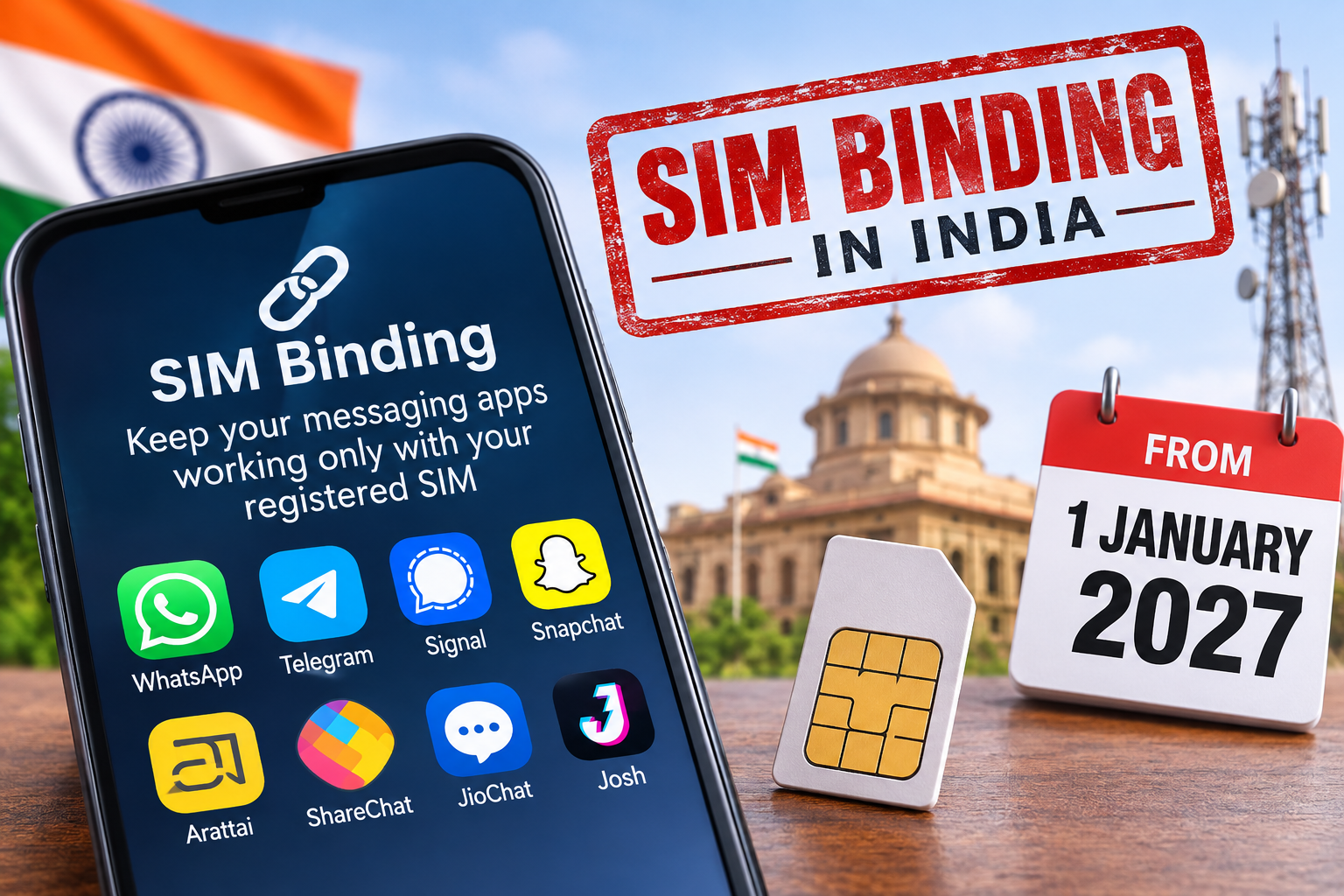
India's SIM binding rule requires WhatsApp, Telegram and six other messaging apps to keep working only while the SIM card you registered with is present and active in your phone. The compliance deadline for the apps is 31 December 2026, so the change is expected to start from 1 January 2027. For most people with one phone and one SIM, little will change. For people who use a Wi-Fi-only tablet, a second phone without a SIM, or a foreign number while abroad, it could mean losing access until they adjust.
Last updated: 13 November 2026. The rule's rollout is still being finalised, and each app will decide how and when to notify users. Details may change before the deadline.
Key Takeaways
- India's Department of Telecommunications (DoT) issued the SIM binding directions on 28 November 2025 under its telecom cyber security rules.
- The order covers eight apps: WhatsApp, Telegram, Signal, Snapchat, Arattai, ShareChat, JioChat and Josh.
- The original deadline passed in early 2026. The government then told Parliament in a written answer on 2 April 2026 that the compliance date is 31 December 2026.
- The original requirement to log users out of web versions every six hours was dropped. Logouts are now meant to follow a risk-based approach.
- An eSIM counts the same as a physical SIM, and dual-SIM phones are allowed, as long as the SIM registered to your account stays active in the same phone.
- Several questions remain open, including how tablets, companion devices and travellers will be treated.
What Is SIM Binding?
Today, you verify a messaging account once with a one-time code sent to your phone number. After that, the account usually keeps working even if you remove the SIM, change phones or switch to Wi-Fi. SIM binding changes that: the app must keep checking that the SIM or eSIM linked to your number is in the device.
In practice, a phone with no SIM, or with a SIM that has expired or been replaced, could not be used for the covered apps. The DoT's stated aim is to stop the misuse of Indian telecom identifiers, in other words mobile numbers, which it says scammers exploit when accounts keep running with no SIM involved.
The Timeline So Far
| Date | What happened |
|---|---|
| 28 November 2025 | DoT issues directions to eight apps. They have 90 days to implement and 120 days to file a compliance report. |
| February 2026 | An industry body whose members include large tech companies sends the DoT a legal opinion calling the rules unconstitutional. The 90-day mark passes without enforcement. |
| April 2026 | Officials say the six-hour web logout is dropped. Meta says it is testing SIM binding with some Indian users. A written Parliament answer (2 April) sets 31 December 2026 as the compliance date. |
| 31 December 2026 | Compliance deadline for the apps. |
| 1 January 2027 | Rule expected to take effect. One official has said rollout could be phased. |
Our arithmetic: 90 days after 28 November 2025 falls around 26 February 2026, and 120 days falls around 28 March 2026. The final deadline therefore sits about 13 months after the original order. From today it is about seven weeks away.
Why the Government Wants It
The DoT argues that the current system has a gap. A criminal can register a messaging account with an Indian number, then run it from another country or from a device with no SIM, which makes the account hard to trace. Officials say that tying an account to an active SIM brings it back within the reach of India's telecom regulations, which already require SIM holders to be verified.
This matters because messaging apps are a common tool in cyber fraud, including the "digital arrest" and impersonation scams that have drawn warnings from officials this year. For a practical guide to those scams, read our explainer on UPI scams and digital arrest fraud in India. Telecom operators have reportedly backed the move, since it keeps messaging accounts tied to their regulated network.
Who Is Affected? A Scenario Guide
| Your situation | Likely effect |
|---|---|
| One phone, one active SIM | Little or no change. |
| Dual-SIM phone | Works, provided the SIM registered with the account stays active in that phone. |
| Number on an eSIM | Counts the same as a physical SIM, according to reports. |
| Registered SIM in a drawer, app running on Wi-Fi | Access may stop. This is the main habit the rule targets. |
| Wi-Fi-only tablet or second phone without a SIM | Unclear. The order says little beyond the web-logout rule, so each app will decide. |
| NRIs and travellers who switch to a local foreign SIM | Could lose access if the Indian SIM is not kept active and in the phone. |
| WhatsApp Web or desktop | No fixed six-hour logout. Sessions end based on risk. |
Readers in the US with Indian family ties should note the last two rows. Many people living abroad keep an Indian WhatsApp number as their main contact, and some of them rely on Wi-Fi without the original SIM. They will need a plan before January.
What Is Still Unclear
- Companion devices. The directions are not specific about tablets, laptops and secondary phones linked to an account.
- Phones versus operating systems. Reports suggest Android apps may comply first, with iPhone apps facing technical constraints. Neither the DoT nor Apple has detailed this publicly in what we found.
- Number transfers and eSIM changes. How the apps handle a lost phone, a new eSIM or a changed handset has not been fully explained.
- Enforcement. One official has said compliance could be phased in, so the experience may differ by app.
- Business accounts. Companies that share one WhatsApp Business number across several staff devices may need to change how they work.
Telegram has said little publicly, though it is widely expected to comply given its large Indian user base. Meta has confirmed testing SIM binding with some users in India. WhatsApp is reported to have roughly 500 million users in the country, though estimates vary.
The Arguments on Each Side
Supporters say the rule closes a real loophole used in fraud. They argue that a mobile number is already a verified identity in India, so linking messaging accounts to it adds accountability without collecting new data. Telecom operators have reportedly welcomed it.
Critics raise three concerns. First, the industry body argued in February that the rules go beyond the law and are unconstitutional. Second, privacy advocates worry that tying every account to a SIM could make it easier to trace people who legitimately want anonymity, such as journalists and activists. Third, they say the rule burdens honest users, especially NRIs, travellers and people who use several devices, while determined criminals may still use SIMs obtained fraudulently.
It is fair to say the policy makes it harder to run an account from nowhere, yet it cannot by itself stop fraud that begins with a legitimately registered SIM. Both sides agree the final outcome depends on how apps and the DoT handle the details.
Practical Steps Before 31 December
- Keep your registered SIM active. Make sure the plan is paid, and be aware that SIMs left unused for long periods can be deactivated.
- Keep the SIM in the phone you use for the app. If you carry two phones, decide which device holds the registered SIM.
- Consider an eSIM. If your phone and operator support it, an eSIM can keep the number active in one device without a physical card.
- Plan for travel. If you go abroad, check that your Indian number stays active, or use roaming, before relying on a local SIM.
- Back up your chats. Use the app's own backup before changing devices or SIMs.
- Watch for in-app notices. Apps will tell users how the change affects them, so read these messages rather than forwarded warnings, many of which exaggerate the rule.
- Check your business setup. If you run a shared business number, ask your provider how it will be handled.
What to Watch Next
- App announcements: in-app notices from WhatsApp, Telegram and Signal about timing and device rules.
- DoT clarifications: any written guidance on tablets, travellers and eSIM changes.
- Legal challenges: whether industry groups or users go to court before or after the rule starts.
- Another extension: the deadline has moved once, so a further delay cannot be ruled out, but nothing has been announced.
The Factora Take
SIM binding is a modest technical change with big consequences for a few groups. If you keep one phone and one active SIM, you probably will not notice it. If you travel, live abroad, or run an app on devices without a SIM, you have about seven weeks to prepare. The sensible approach is neither panic nor dismissal: assume the rule will start in January, expect some phased rollouts and confusion, and make sure your registered SIM is safely active. The deeper question, how much identity checking messaging apps should carry in the name of fraud prevention, will continue long after this deadline.
This article is for general information only. It is not legal or technical advice. Rules and app behaviour may change, so check official DoT notices and each app's announcements.
Frequently Asked Questions
What is SIM binding in India?
It is a DoT requirement that messaging apps such as WhatsApp and Telegram keep working only while the SIM or eSIM linked to your registered number is present and active in your phone.
When does SIM binding start?
The compliance deadline for the apps is 31 December 2026, with the change expected from 1 January 2027. Officials have said rollout could be phased.
Will WhatsApp Web still log me out every six hours?
No. That requirement was dropped. Web and desktop sessions are meant to end based on a risk assessment, with no fixed interval.
Does SIM binding work with dual-SIM phones and eSIMs?
Yes, reports say dual-SIM phones are allowed and an eSIM counts the same as a physical SIM, as long as the registered SIM stays active in the same phone.
What happens if I am abroad and use a local SIM?
Access could be affected if the app cannot verify your registered Indian SIM. Keep the Indian SIM active and in the phone, or use roaming, and watch for guidance from the apps.
Related articles