Home Loan EMI After the RBI Rate Hike: Increase EMI, Extend Tenure or Prepay?
Last updated: 11 November 2026. Lending rates, bank policies and tax rules change and differ by lender and loan type. The examples below are illustrations based on stated assumptions, not personalised advice. Check your loan agreement and speak to your lender or a qualified adviser before making decisions.
If you have a floating-rate home loan, October's RBI decision probably reached your bank statement. On 7 October the Reserve Bank of India raised the repo rate by 25 basis points to 5.50 percent and signalled a "calibrated tightening" stance. Within days, State Bank of India increased its benchmark lending rates, and other lenders have been adjusting too. For borrowers the key question is not just "will my EMI go up?" but "what should I do about it?" Here is a clear, step-by-step guide.
Key Takeaways
- SBI raised its External Benchmark Lending Rate (EBLR) from 7.90 percent to 8.15 percent and its repo-linked rate from 7.50 percent to 7.75 percent (plus the applicable spread), effective 15 October 2026.
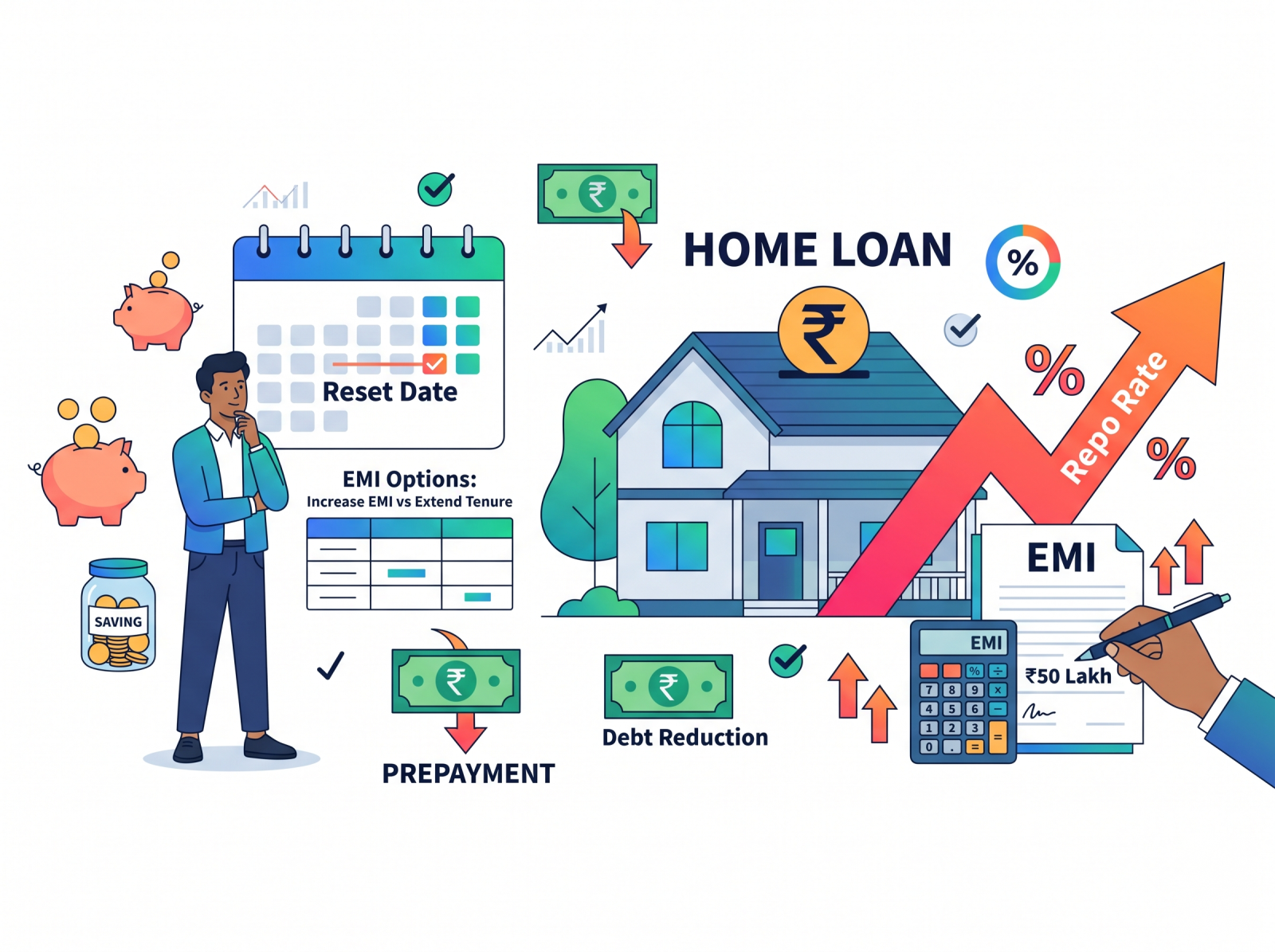
- On a ₹50 lakh loan with 20 years left, a 25 basis point rise adds about ₹781 to the monthly EMI, or about ₹1.9 lakh in extra interest over the full term.
- Many lenders protect your EMI by quietly extending the tenure instead. That feels painless but means you stay in debt longer and pay more interest.
- Under RBI rules, lenders cannot charge prepayment penalties on floating-rate loans to individuals for non-business purposes, so extra payments are generally free.
- Even small, regular prepayments early in the loan can cut years off the tenure.
What Actually Happened to Your Loan Rate
Most new floating-rate home loans in India are linked to an external benchmark such as the repo rate. The lender adds a fixed spread, which depends on your credit profile and loan product, and the combined rate is reset at set intervals, often quarterly. When the RBI raised the repo rate, banks revised their benchmarks, and borrowers on those benchmarks will see the higher rate at their next reset date. SBI's revision took effect on 15 October 2026. Different banks and products reset on different dates, so check your own account statement or sanction letter for the benchmark and reset schedule.
The Math: What a 25 Basis Point Rise Costs
Here is an illustration for a ₹50 lakh loan with 20 years remaining. The figures are calculated on a standard EMI formula and exclude any changes in fees.
| Scenario | EMI | Remaining tenure | Total interest (approx.) |
|---|---|---|---|
| Before the hike (8.00%) | About ₹41,822 | 20 years | About ₹50.4 lakh |
| After the hike, EMI rises (8.25%) | About ₹42,603 | 20 years | About ₹52.2 lakh |
| After the hike, EMI unchanged (8.25%) | About ₹41,822 | About 21 years | About ₹55.3 lakh |
In the third row, the monthly payment feels unchanged, but the loan lasts about a year longer. That is the hidden cost of "no change in EMI" when rates rise.
Your Three Options
Option 1: Increase your EMI
If your budget allows, paying the higher EMI keeps the original tenure and gives the lowest total interest cost. It is the cleanest option, but it needs monthly cash flow.
Option 2: Accept a longer tenure
This keeps the monthly outgo steady and may suit you if cash flow is tight. The trade-off is more total interest and a later end date. If you choose this, set a reminder to shorten the tenure later when your income rises or rates fall.
Option 3: Keep the EMI, then prepay to claw back the tenure
You can let the tenure extend and then use bonuses, savings or annual increments for part-prepayments. As long as you have a floating-rate loan, you can generally prepay without penalty, which brings us to the next point.
The Prepayment Advantage
RBI's directions on prepayment charges apply to loans sanctioned or renewed on or after 1 January 2026, and they bar lenders from levying prepayment charges on floating-rate loans to individuals for non-business purposes. A similar rule for floating-rate home loans has existed for years, so most existing floating-rate borrowers also prepay without charges. Fixed-rate loans, and loans outside these categories, can have fees, so check your agreement.
Interest is calculated on the outstanding balance, so every rupee of principal repaid early saves interest for the rest of the loan. Here is an illustration on the same ₹50 lakh, 8.25 percent loan:
| Strategy | Approximate result |
|---|---|
| Pay the regular EMI of about ₹42,603 for 20 years | Total interest of about ₹52.2 lakh |
| Add ₹5,000 extra every month from the start | Loan ends in about 15.6 years, about 4.5 years sooner, and total interest falls to about ₹39 lakh, a saving of roughly ₹13 lakh |
These are indicative figures that assume a constant rate. In reality the rate will move, so your actual saving will differ, but the direction is the same: early and regular prepayments have the biggest impact.
Other Ways to Cut the Cost
- Ask for a lower spread. If your credit score has improved since you took the loan, ask your lender to reduce your spread. Some banks will do this for a modest fee or at no cost, though policies vary.
- Check a balance transfer carefully. Moving to another lender can save money if the rate gap is meaningful, but processing fees and charges apply. Compare the full cost, not just the headline rate.
- Know the conversion fee. Switching from an old benchmark to a newer one within the same bank can attract a fee, which one industry executive says is commonly around 0.25 to 0.50 percent of the outstanding principal plus GST. Ask for the exact figure.
- Consider tax benefits. Under the old tax regime, deductions are available for home loan interest and principal repayment within specified limits. Whether they help you depends on which regime you use, so check the current rules.
- Protect your emergency fund first. Do not drain all your savings into prepayment. Keep several months of expenses liquid, as we explained in our guide on protecting your savings from rising inflation.
What to Watch Next
- The RBI's December meeting, scheduled for 2 to 4 December 2026. Another hike would raise rates again.
- Inflation data. India's retail inflation was 5.54 percent in September, and the RBI has said future moves depend on inflation and growth.
- Your lender's reset date. Check when your rate next changes and whether the lender will adjust EMI or tenure.
- Deposit rates. Banks do not always raise FD rates immediately after a repo hike, so compare before moving savings.
The Factora Take
Rate hikes feel abstract until they reach your EMI, and the most expensive response is to ignore them. The simplest approach is to know your numbers: your current rate, your remaining tenure and what a 25 basis point change really costs. Then decide deliberately between a higher EMI, a longer tenure or targeted prepayments. A few thousand rupees a month, started early, can be worth lakhs by the end of the loan.
Frequently Asked Questions
Will my home loan EMI go up after the RBI rate hike?
If your loan is floating and linked to a benchmark that changed, your rate will rise at the next reset. The lender may increase your EMI or extend your tenure, depending on its policy and your account settings.
How much does a 25 basis point hike add to an EMI?
On a ₹50 lakh loan with 20 years remaining, it adds roughly ₹781 per month, assuming the tenure stays unchanged.
Is it better to increase EMI or extend the tenure?
Increasing the EMI usually costs less in total interest, while extending the tenure eases monthly cash flow but increases the total cost. The right choice depends on your budget.
Can I prepay my home loan without penalty?
For floating-rate loans to individuals for non-business purposes, RBI rules bar prepayment charges, so part or full prepayment is generally free. Check your agreement for fixed-rate or special products.
Should I switch to another bank for a lower rate?
Only if the savings clearly exceed the processing and transfer costs. Compare the all-in cost, and also ask your current lender whether it can reduce your spread.
Related articles