EPF Withdrawal Rules 2026: What "100% Withdrawal" Really Means
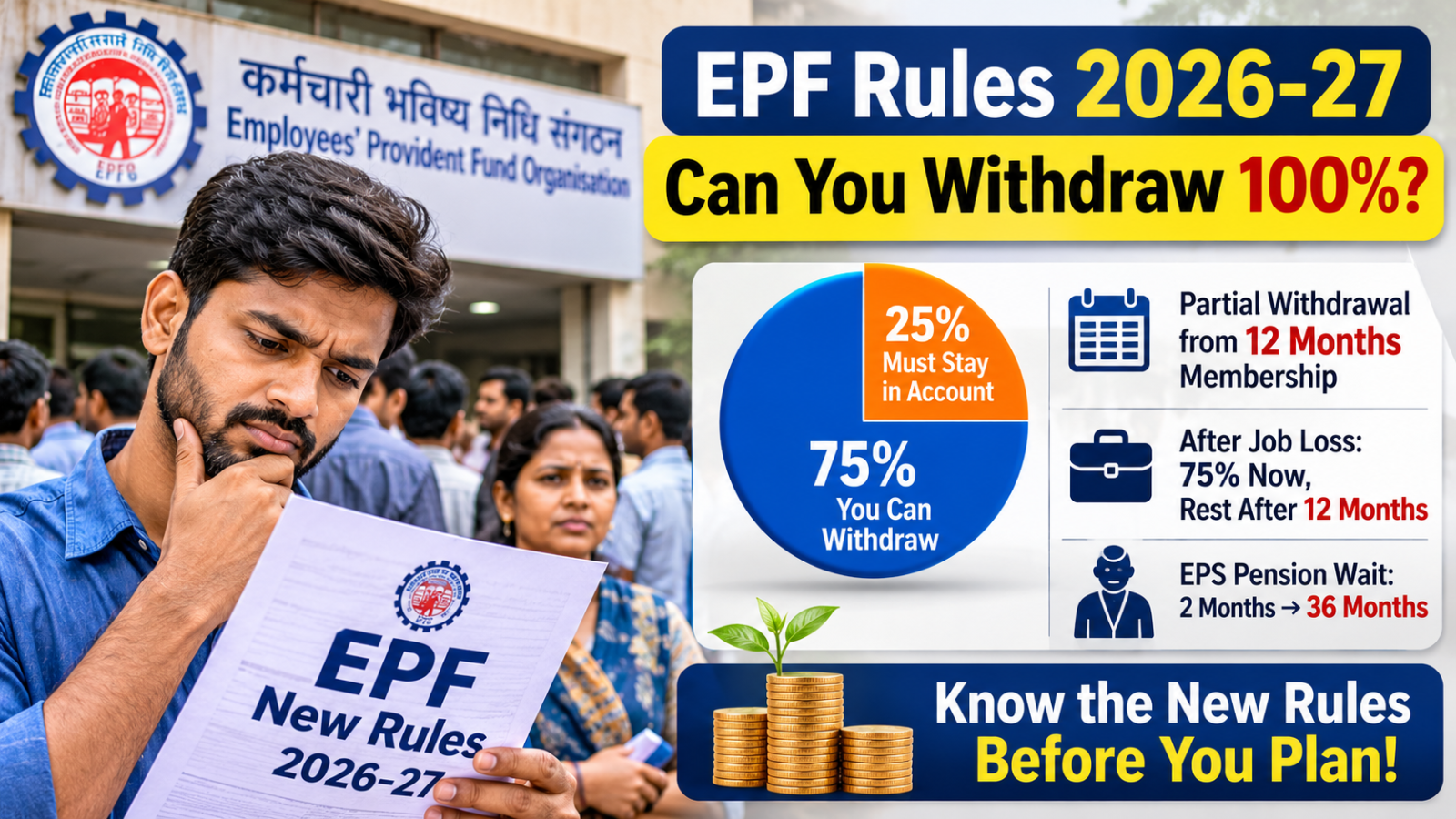
The headline said you can now withdraw 100% of your EPF. The fine print says something different. Under EPFO's new framework, you can take up to 75% of your total balance, and the other 25% must stay in the account as a minimum balance that keeps earning interest, currently 8.25% a year. Partial withdrawals now need only 12 months of membership, but if you lose your job, getting that last 25% out takes 12 months of unemployment, up from two. If you change jobs often or rely on your PF as an emergency cushion, these details matter.
Last updated: 15 November 2026. EPFO's rules are detailed and have been reported in different ways. Check the EPFO website or your UAN account before you file a claim. This is general information, not financial or legal advice.
Key Takeaways
- EPFO merged 13 partial withdrawal provisions into three categories: Essential Needs, Housing Needs and Special Circumstances.
- "100% of eligible balance" really means 75% of your total, because 25% is set aside as a minimum balance.
- Every partial withdrawal now needs only 12 months of membership. Earlier waiting periods ranged up to seven years for some purposes.
- After losing a job, the Labour Minister said up to 75% can be withdrawn immediately. The remaining 25% is available after 12 months of continuous unemployment.
- The wait to withdraw pension (EPS) benefits has been extended from two months to 36 months.
Why the headlines said "100%"
The confusion started with the announcement on 13 October 2025, after the Central Board of Trustees (CBT) of the Employees' Provident Fund Organisation met under Labour Minister Mansukh Mandaviya. The Labour Ministry's statement said members could withdraw "up to 100% of eligible balance". Many outlets and social media posts dropped the word "eligible".
Here's how it fits together. The board earmarked 25% of your contributions as a minimum balance you must maintain at all times. The "eligible balance" is everything above that. So 100% of the eligible balance is 75% of your total, and it now counts both your share and your employer's share, plus interest. The Labour Minister later clarified the point publicly after the confusion spread.
What changed, side by side
| Item | Before | Now |
|---|---|---|
| Partial withdrawal rules | 13 separate provisions | 3 categories |
| Minimum service | Varied, up to about seven years for some purposes | 12 months for all |
| Education and marriage withdrawals | Three in total | Up to 10 for education, 5 for marriage |
| Minimum balance | None required | 25% of contributions must stay |
| After job loss | 75% after one month, the rest after two | 75% immediately, the rest after 12 months |
| Pension (EPS) withdrawal wait | Two months | 36 months |
Reports also say claims up to ₹5 lakh can now be auto-settled without manual review, which is why many claims clear in a few days. We couldn't find the full current limit on EPFO's own pages, so check it before you count on it.
What 25% locked actually costs you
Take a simple, made-up example. Your PF balance is ₹4,00,000. The 25% minimum is ₹1,00,000. The most you could withdraw is ₹3,00,000, with the rest staying put and earning interest.
Now think about what the ₹3,00,000 would have done if you'd left it alone. At a constant 8.25% a year, which is hypothetical because EPFO resets the rate every year, it would grow to roughly ₹4,46,000 in five years, about ₹6,63,000 in ten and about ₹9,85,000 in fifteen. That's the real price of an early withdrawal: not the money you take out, but the interest you give up on it. There are sometimes good reasons to take that price. A medical bill or a home down payment can justify it. A holiday probably doesn't.
The job-switch trap
This is the part that catches people out. Say you leave a job and don't start a new one for a few months. Under the new rules you can access 75% of your balance, but the remaining 25% isn't available for final settlement until you've been unemployed for 12 months. Under the old system, you could draw nearly everything after two months. So the "I'll just withdraw it all while I'm between jobs" plan no longer works.
If you've got another job lined up, the better route is usually a transfer, not a withdrawal. Moving your account to your new employer's UAN keeps your service continuous and your balance growing. Withdrawing and starting over can also affect your continuity of service, which matters for the tax rules covered below.
Pension money: the 36-month wait
The Employees' Pension Scheme (EPS) is the part of your employer's contribution that goes towards a pension rather than your PF balance. The waiting period to withdraw the EPS benefit has been extended from two months to 36 months. The aim, as explainers describe it, is to encourage people to build up pensionable service. For anyone who changes jobs every couple of years, it's worth knowing that the pension component can't be cashed out quickly.
Tax points to check
- TDS on early withdrawals. Tax is generally deducted at source if you withdraw more than ₹50,000 before completing five years of continuous service, with exceptions for specified situations. Check the current rate and whether your PAN is linked.
- Interest on large contributions. Interest on your own annual contributions above ₹2.5 lakh is generally taxable.
- Transfers vs withdrawals. Transferring your account to a new employer isn't treated as a withdrawal, so it avoids these issues.
Tax rules can change and depend on your circumstances. Our own simplified summary isn't a substitute for professional advice.
Both sides of the trade-off
Why did the government do this? The Labour Ministry has explained that frequent withdrawals leave many workers with very small balances at retirement, so a minimum balance and a longer wait before full settlement are meant to protect long-term savings. It also argues that simpler categories and faster digital claims make life easier for the more than seven crore members.
The other side of that coin is plain. For someone in a real emergency, or between jobs for longer than expected, a locked quarter of their balance can feel like their own money being held back. Both points are fair. Simplified access and shorter service requirements are genuine improvements for most people, and the longer waits are a genuine restriction for others. Which matters more depends on whether you're someone who tends to withdraw early or someone who needs flexibility in a crisis.
A practical checklist
- Check your UAN is active and your Aadhaar, bank account and mobile number are linked.
- Look at your passbook on the EPFO portal or the UMANG app. Work out your total, your 25% minimum and your eligible balance.
- Count your months of membership. Under 12 months means no partial withdrawal for any purpose.
- Choose the right category for your claim: Essential Needs, Housing Needs or Special Circumstances.
- Prefer a transfer over a withdrawal if you're changing jobs.
- Keep paperwork, since some claims still need supporting documents.
- Beware of "agents". Nobody needs to pay a fee or share an OTP to get your own PF. See our guide to UPI scams and digital arrest fraud.
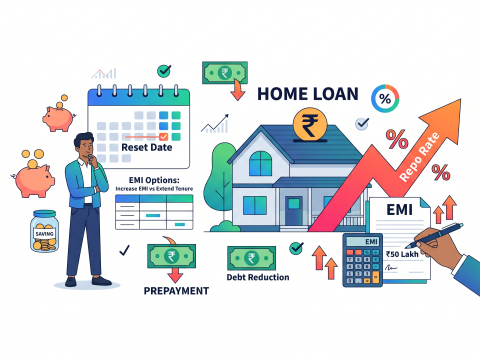
If you're thinking of using your PF for a home loan, remember that the housing category allows large withdrawals for buying, building or repaying a loan, but the 25% floor still applies. Our guide to home loan EMIs after the RBI rate hike explains how to weigh options.
What to watch next
- EPFO's annual interest rate for the current financial year, which is set by the board and then approved by the government.
- UPI and ATM-style withdrawals under EPFO 3.0, which have been reported as rolling out in stages.
- Further clarifications on the Labour Ministry or EPFO websites, since earlier explanations were contradictory.
- Any change in the wage ceiling for mandatory coverage. Reports differ on whether it has changed, so check EPFO before relying on a figure.
The Factora Take
The new EPF rules are better than the old ones in most ways that matter day to day: fewer categories, less paperwork, shorter service requirements, and faster claims. The catch is the part that didn't make the headlines. Keeping a quarter of your balance locked, and making the final withdrawal wait a year, changes how PF works as a safety net. If you think of your PF as a retirement fund, the rules help you. If you think of it as an emergency account, you need a second cushion. Either way, read past the word "100%" before you plan anything around it.
This article is for education and information only. It is not personalised financial, tax or legal advice. Rules change and details vary by case, so confirm with EPFO or a qualified professional before acting.
Frequently Asked Questions
Can I withdraw 100% of my EPF now?
Not in the sense most headlines suggest. You can withdraw up to 100% of your "eligible balance", which is your total minus the 25% minimum balance. In practice that is up to 75% of the total. Full withdrawal of the whole balance is allowed in specified cases, such as retirement or 12 months of continuous unemployment.
How long must I be a member before a partial withdrawal?
Twelve months of membership for all three categories of partial withdrawal.
What happens to my PF if I lose my job?
The Labour Minister said up to 75% can be withdrawn immediately. The remaining 25% can be withdrawn after 12 months of continuous unemployment, or earlier in specified cases such as retirement.
Does the 25% minimum balance earn interest?
Yes. It continues to earn EPFO's annual interest, which was 8.25% in the rate cited by the announcement. The rate is set each year.
What is the new wait for EPS pension withdrawal?
36 months after leaving employment, up from two months, under the new framework.
Related articles