Medicare Part D 2027: What Changes and What to Check by Dec 7
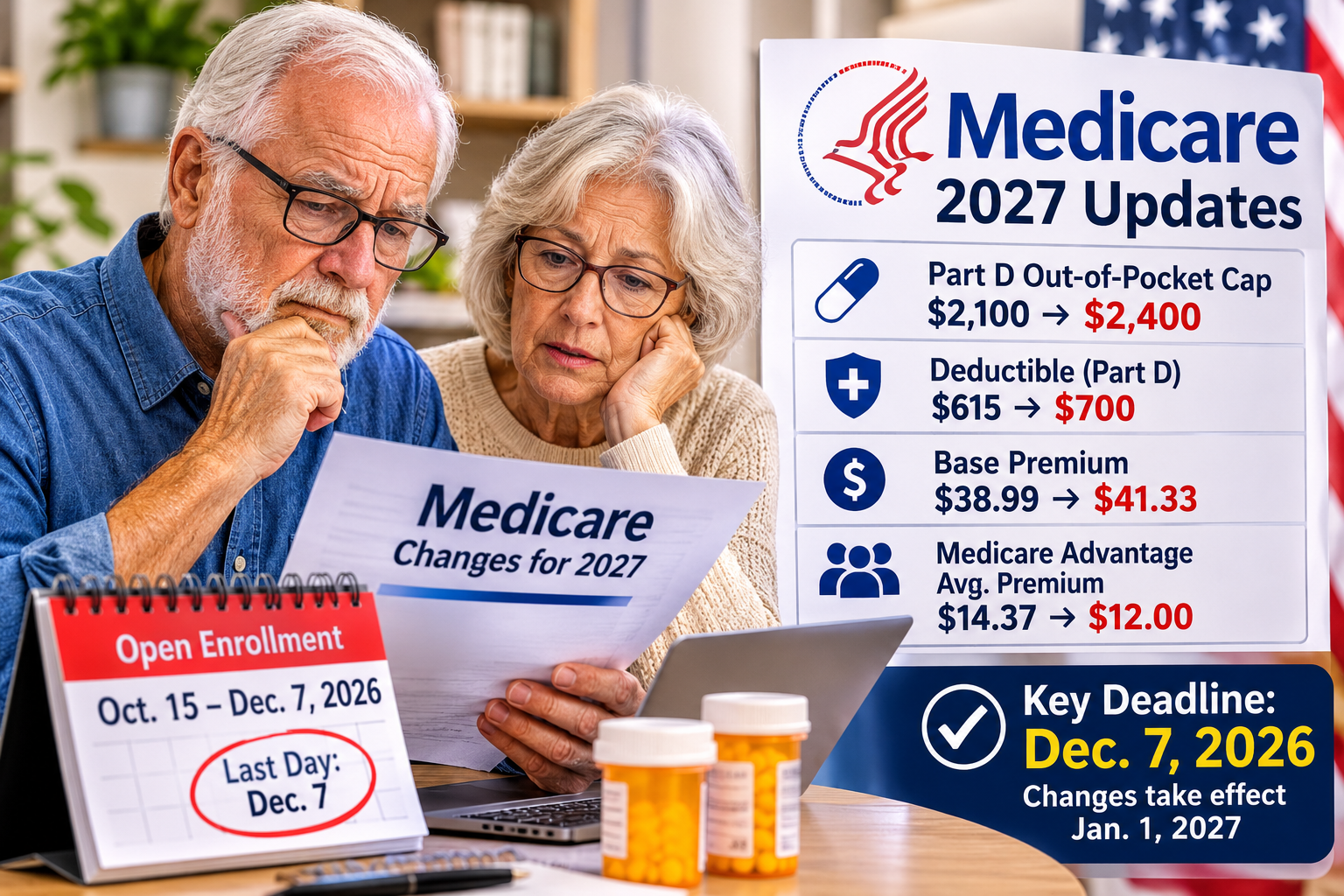
Medicare's prescription drug rules reset on 1 January 2027, and the window to change plans closes on 7 December. The yearly cap on what you pay out of pocket for covered drugs rises from $2,100 to $2,400. The standard Part D deductible goes from $615 to $700. The base premium climbs about 6%, a temporary federal premium support program ends, and negotiated prices for 15 more drugs, including Ozempic, start next year. If you do nothing, your current plan will simply roll over, and its costs may not match what you pay today.
Last updated: 14 November 2026. The official 2027 Part B premium had not been confirmed at the time of writing and is usually announced in mid-November. This article is general information, not personal advice.
Key Takeaways
- Medicare open enrollment runs from 15 October to 7 December 2026. Changes take effect on 1 January 2027.
- The Part D out-of-pocket cap rises $300, to $2,400. The standard deductible rises $85, to $700. Both are final, set by CMS.
- The national base beneficiary premium rises to $41.33, up from $38.99, the maximum 6% increase the law allows.
- CMS says the average Medicare Advantage premium will fall to $12.00 a month, from $14.37, but the in-network out-of-pocket maximum rises to $9,850 from $9,250.
- Social Security's 2027 cost-of-living adjustment is 3.6%. The 2027 Part B premium is still an estimate of $209.50 a month until CMS confirms it.
The 2027 numbers in one place
| Item | 2026 | 2027 | Status |
|---|---|---|---|
| Part D out-of-pocket cap | $2,100 | $2,400 | Final |
| Part D standard deductible (maximum) | $615 | $700 | Final |
| Base beneficiary premium | $38.99 | $41.33 | Final (CMS, 28 July 2026) |
| Average Medicare Advantage premium | $14.37 | $12.00 | CMS projection (28 Sept 2026) |
| Medicare Advantage in-network out-of-pocket maximum | $9,250 | $9,850 | Upper limit set by CMS |
| Standard Part B premium | $202.90 | About $209.50 | Trustees' estimate; not yet official |
Do the math on the headline changes: the cap goes up $300, which is 14.3% on $2,100. The deductible goes up $85, about 13.8% on $615. The base premium rises $2.34, which is 6.0% on $38.99, exactly the ceiling the law sets for annual increases.
What the cap really means for you
The cap is the single most helpful feature of the Part D redesign. Once your out-of-pocket spending on covered drugs reaches $2,400 in a calendar year, you pay nothing more for those covered prescriptions until the year ends. For someone on an expensive medicine, that is a ceiling on a risk that used to have no ceiling at all.
But a higher cap isn't free. Here are two simple examples under the standard benefit, which assumes a $700 deductible and 25% coinsurance afterwards. Your plan may differ, and many plans use copays or a lower deductible, so check yours.
- An expensive drug at $1,500 a month. You pay the $700 deductible plus 25% of the rest in month one, about $900. By month five you reach $2,400, and after that, nothing. In 2026 you'd have stopped at $2,100.
- A modest drug at $100 a month, $1,200 a year. In 2026 you'd pay about $761 ($615 plus 25% of the remaining $585). In 2027 you'd pay about $825 ($700 plus 25% of the remaining $500). That's roughly $64 more, with no cap involved.
The point isn't the exact figures. It's that people on cheap drugs feel the higher deductible, and people on expensive drugs feel the higher cap. Neither group should be surprised in January.
The quiet change: a premium support program ends
For the past two years, the government ran a "Premium Stabilization Demonstration", which gave standalone drug plans extra support in the form of a fixed reduction in the base premium and a limit on how much plan premiums could rise. CMS says it ends after 2026 and that the market returns to "traditional" conditions in 2027.
A separate rule in the Inflation Reduction Act still caps the increase in the national base premium at 6% a year through 2029. But that cap applies to a national benchmark, not to your individual plan's price. Your own premium can move by more or less. Some stand-alone plans may jump, some may drop out of your area, and a few insurers are scaling back Medicare Advantage benefits or leaving certain regions entirely. Those are the cases where checking matters most.
Fifteen drugs get negotiated prices
On 1 January 2027, Medicare's negotiated prices take effect for a second group of 15 drugs. CMS announced them on 25 November 2025. The best-known is semaglutide, sold as Ozempic, Wegovy and Rybelsus, which will have a negotiated price of $274 for a 30-day supply, about 71% below a $959 list price. The list also includes Trelegy Ellipta, Xtandi, Ibrance, Calquence, Pomalyst, Ofev, Linzess, Austedo, Breo Ellipta, Xifaxan, Vraylar, Tradjenta, Janumet and Otezla. Discounts range from roughly 38% to 85% off list prices.
Two cautions. First, the negotiated price is what Medicare and your plan pay, not your bill. What you pay depends on your plan's tier, your deductible and where you are relative to the cap. Second, Part D generally doesn't cover Wegovy when it is prescribed only for weight loss, so the negotiated price won't apply in that case. Check whether your plan covers the drug for your condition.
Your Social Security raise, and the part that isn't final
The Social Security Administration announced a 3.6% cost-of-living adjustment for 2027 on 14 October. For someone receiving a $2,300 monthly check, that is $82.80 more. Medicare Part B premiums come out of that check first. If the Trustees' estimate of a $6.60 increase holds, the net gain would be about $76.20 a month. That's an estimate: CMS usually confirms the real Part B premium, deductible and the income brackets for the higher-income surcharge (IRMAA) in mid-November. Last year it did so on 14 November. If the official figure comes in above $209.50, the gain shrinks dollar for dollar.
If your income is high enough to trigger IRMAA, the surcharge is based on your tax return from two years earlier, so for 2027 CMS will look at 2025. It can wipe out the entire raise, and it's worth knowing which bracket you fall into.
What to do before 7 December
- Read your Annual Notice of Change. Your plan has to send it. It lists changes to premiums, deductibles, drug tiers and networks for 2027.
- List every prescription, with doses. Include how often you fill each one, and the pharmacy you use.
- Run them through Medicare's Plan Finder at Medicare.gov, comparing your current plan against alternatives. Compare total yearly cost, not just the monthly premium.
- Check each drug's tier and whether it requires prior authorisation. A cheap premium can hide an expensive drug tier.
- Consider the Medicare Prescription Payment Plan. It lets you spread your out-of-pocket costs across the year in monthly payments with no interest, which helps if you hit the cap early in the year.
- If you're in Medicare Advantage, note that you also get a window from 1 January to 31 March to make one change, but acting now is cleaner.
- Get free help. Your State Health Insurance Assistance Program (SHIP) offers unbiased counselling, and you can call 1-800-MEDICARE.
If you still contribute to a health savings account, remember that contributions generally stop once you enrol in Medicare. Our guide to HSA vs FSA limits for 2027 explains the rules.
What to watch next
Three things. First, the official 2027 Part B premium and IRMAA brackets from CMS, expected in mid-November. Second, whether your own plan changes its drug list or pharmacy network in the notice you receive. Third, any new plan closures in your area, which can trigger a special enrolment period. The 7 December deadline is firm for most people, so don't leave it until the last night.
The Factora Take
Medicare's drug benefit is quietly becoming more predictable at the top and more expensive at the bottom. The cap protects people with big drug bills, which is exactly its purpose, while the higher deductible nudges up costs for people who take a few cheaper pills. Add the end of a premium support program and a 3.6% raise that can be partly eaten by Part B, and a shrug is the wrong response. The good news is that it's one of the few areas of personal finance where an hour of comparison can reliably save money. Set aside that hour before 7 December.
This article is for education and information only. It is not personalised medical, insurance or financial advice. Plan details and rules vary by plan and location, so check Medicare.gov, your plan's documents or speak with a licensed adviser or SHIP counsellor.
Frequently Asked Questions
What is the Medicare Part D out-of-pocket cap for 2027?
It is $2,400, up from $2,100 in 2026. After you spend that much on covered drugs in a year, you pay nothing more for those covered prescriptions until the year ends.
When is Medicare open enrollment?
From 15 October to 7 December 2026. Changes you make take effect on 1 January 2027.
What happens if I don't change my plan?
Your current plan generally continues into 2027, but with whatever new premiums, deductibles, drug tiers and networks it has set. That's why reading your Annual Notice of Change matters.
Will Ozempic cost $274 a month for me?
Not necessarily. $274 is the negotiated price Medicare and your plan pay for a 30-day supply from 1 January 2027. Your share depends on your plan, your deductible and the cap, and Part D generally doesn't cover Wegovy for weight loss alone.
What is the 2027 Medicare Part B premium?
The official amount hadn't been confirmed when we published. The Medicare Trustees estimated $209.50 a month, up from $202.90, and CMS usually announces the final figure in mid-November. Check CMS or Medicare.gov.
Related articles