High-Yield Savings vs. CDs in 2027: Where to Park Cash as Interest Rates Shift
Cash management has entered a pivotal transition period. For the past two years, savers benefited from Federal Reserve policy keeping benchmark interest rates elevated, allowing cash parked in risk-free accounts to generate 4% to 5% annualized yields. However, with economic forecasts pointing toward recalibrated monetary policy, maintaining that momentum requires a more deliberate approach.
For everyday Americans balancing monthly liquidity against longer-term emergency reserves, the choice largely narrows down to two foundational vehicles: High-Yield Savings Accounts (HYSAs) and Certificates of Deposit (CDs). Understanding how each responds to shifting rate environments is essential to maximizing interest without locking away critical funds.
High-Yield Savings Accounts: Maximum Flexibility
High-Yield Savings Accounts remain the backbone of household emergency planning. Typically offered by online financial institutions and fintech platforms with lower overhead expenses, these accounts offer yields significantly higher than the national traditional bank average.
Primary Advantages:
- Unrestricted Liquidity: Funds can generally be transferred or withdrawn without structural penalty, provided standard federal and banking transaction rules are observed.
- FDIC Insurance Protection: Deposits are backed by federal insurance up to $250,000 per depositor, per insured institution.
- Simplicity: They integrate directly with checking accounts, making them ideal for emergency reserves covering 3 to 6 months of basic expenses.
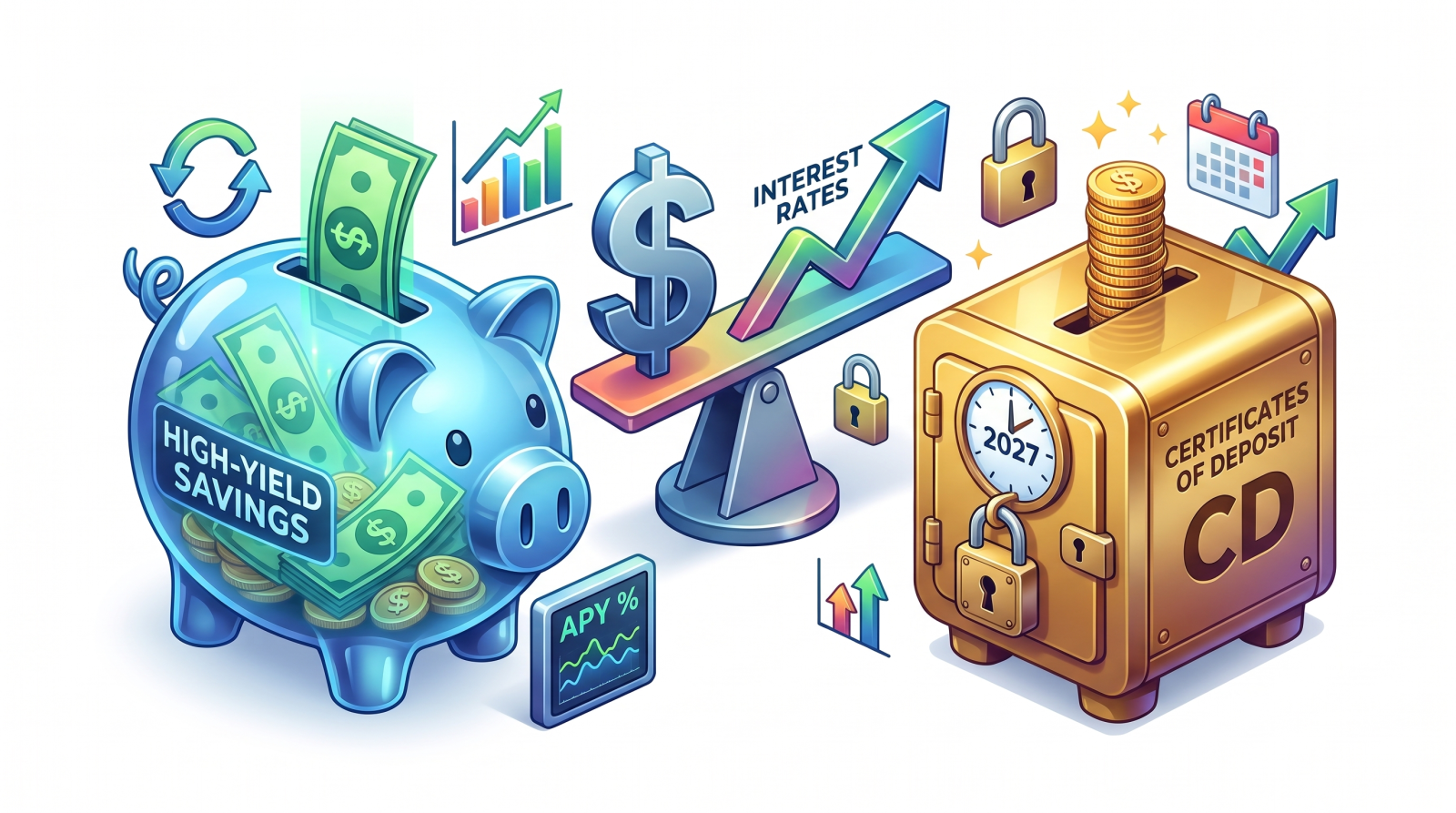
The Variable Rate Trade-Off: The primary drawback of an HYSA is rate volatility. Annual Percentage Yields (APYs) on savings accounts are variable. If the Federal Reserve reduces the federal funds rate, online institutions adjust their yields downward almost immediately, meaning today's 4.5% yield can decline over subsequent billing cycles.
Certificates of Deposit: Securing Today’s Rates
A Certificate of Deposit operates as a time-deposit agreement between the saver and the banking institution. In exchange for committing a fixed balance for a specified term—ranging commonly from 6 months to 5 years—the bank guarantees a fixed APY throughout the entire duration.
Primary Advantages:
- Rate Certainty: Regardless of broader financial market shifts or Federal Reserve rate reductions, the contracted interest rate remains unchanged until maturity.
- Disciplined Saving: The commitment structure discourages premature spending on non-essential purchases.
- Predictable Returns: Savers can calculate exact interest payouts in advance for planned near-term capital goals, such as a home down payment.
The Illiquidity Constraint: The primary constraint of a CD is the early withdrawal penalty. Accessing deposited funds prior to the maturity date typically triggers a penalty equivalent to several months of earned interest, negating much of the yield benefit.
HYSA vs. CD: Strategic Breakdown
| Feature | High-Yield Savings (HYSA) | Certificate of Deposit (CD) |
|---|---|---|
| Interest Rate Type | Variable (moves with federal rates) | Fixed (locked for entire term) |
| Access to Money | Immediate and flexible | Restricted until maturity date |
| Early Penalty | None | Typically 3 to 6 months of interest |
| Best For | Emergency funds and buffer cash | Planned future purchases (1–3 years) |
The Hybrid Approach: Building a CD Ladder
Rather than choosing exclusively between total liquidity and full commitment, many savers adopt a structured CD laddering strategy. This involves dividing cash reserves into multiple tranches across staggered maturity intervals.
For instance, an individual with $10,000 to allocate might deploy the capital as follows:
- $2,500 into a High-Yield Savings Account for direct emergency access.
- $2,500 into a 6-month CD.
- $2,500 into a 12-month CD.
- $2,500 into an 18-month CD.
As each certificate matures, the balance can either be utilized without penalty or rolled into an updated term at prevailing rates. This creates regular liquidity intervals while protecting a portion of overall savings from potential interest rate declines.
Action Checklist for Managing Cash Reserves
1. Maintain liquid core reserves first: Before committing funds into fixed-term products, keep a baseline emergency reserve readily available inside a standard HYSA.
2. Verify FDIC or NCUA backing: Always confirm that any institution offering elevated promotional APYs carries active FDIC insurance for banks or NCUA coverage for credit unions.
3. Align terms with explicit goals: Use fixed-term CDs strictly for earmarked funds that will not be required prior to the maturity schedule.
Related articles