
Physics Beyond Limits: Scientists Uncover Space-Time Quantum Boundary Capable of Accelerating Electronics 100,000x
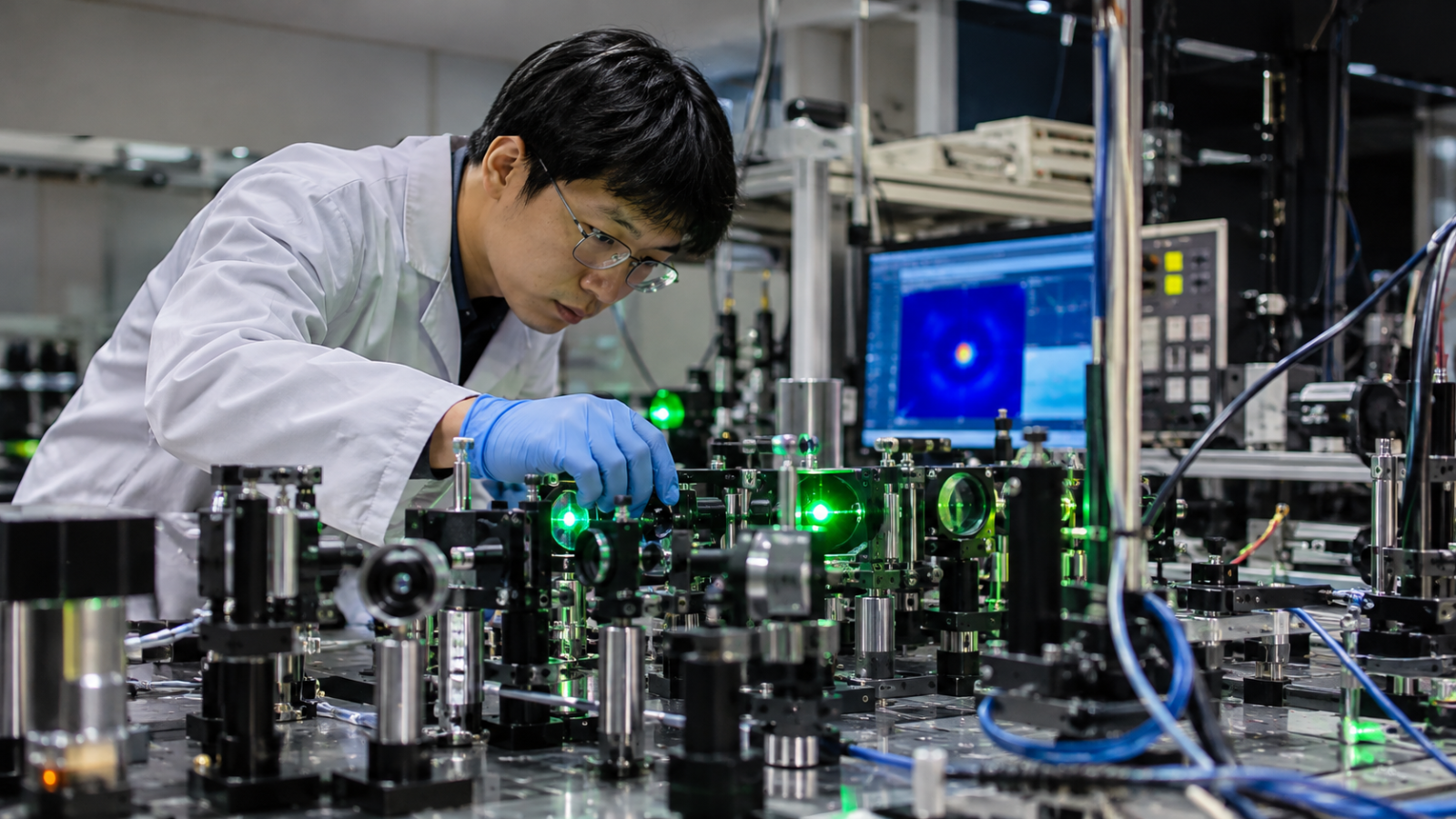
Modern computing faces a relentless physical obstacle: the heat, resistance, and microscopic speed limits inherent to standard silicon semiconductors. However, a major discovery in quantum physics has identified a previously uncharted boundary within space and time that governs how electrons move at subatomic scales. The breakthrough, led by research teams at the University of Regensburg, demonstrates that manipulating quantum wavefunctions at attosecond speeds could pave the way for electronic switching systems operating up to 100,000 times faster than today's most powerful microprocessors.
By exposing a subtle quantum restriction that dictates where and when an electron can be measured, the study opens a new frontier in condensed-matter physics, moving the industry closer to petahertz-scale computing and direct optical-electronic control.
The Discovery: Peering Past Heisenberg’s Classical Horizon
For nearly a century, Werner Heisenberg’s Uncertainty Principle has established that certain conjugate properties of quantum particles—such as precise position and momentum—cannot be simultaneously known with infinite precision. Yet the relationship between an electron’s location in space and its passage through time remained an elusive domain of experimental science.
To inspect this elusive interaction, researchers developed a specialized scanning-tunneling microscope coupled with phase-locked, ultrafast infrared laser pulses. This apparatus allowed the team to track electron wave packets across intervals lasting merely tens of attoseconds (one quintillionth of a second).
Key experimental observations from the study include:
- The Spatial-Temporal Limit: Measurements revealed a hard quantum ceiling where localized tracking of an electron in physical space fundamentally distorts the certainty of its temporal window.
- Attosecond Pulse Injection: Light-wave cycles were used to pull and push individual electrons across a vacuum junction without causing thermal breakdown or thermal scatter.
- Wavefunction Coherence: The system demonstrated that electrons could be directed coherently as wave-like entities rather than slow, colliding particles, minimizing energy dissipation.
Silicon Bottlenecks vs. Quantum Wave Switching
Modern commercial silicon transistors operate in the gigahertz (GHz) domain, cycling several billion times per second. Increasing clock speeds further has resulted in excessive thermal throttling and leakage current. The new quantum-controlled mechanism bypasses conventional gating entirely by shifting the driving mechanism from voltage changes to coherent optical field oscillations.
| Architecture Metric | Standard Silicon Transistors | Attosecond Quantum Electronics |
|---|---|---|
| Operational Frequencies | 3.0 to 6.0 GHz | Petahertz (PHz) domain (~100,000x gain) |
| Switching Medium | Gate voltages & physical carrier drift | Laser-driven quantum tunneling & wavefunction shifts |
| Thermal Waste | High heat output via electrical resistance | Near-zero ohmic loss due to coherent ballistic motion |
| Primary Application | General-purpose silicon computing | Ultrafast quantum processors, real-time chemical tracking |
Transformative Implications Across Tech and Chemistry
The practical reach of this research extends far beyond raw processor speeds. Because chemical reactions fundamentally consist of electrons rearranging themselves between molecular orbitals across attosecond timescales, understanding this space-time constraint allows scientists to intervene in molecular dynamics as they happen.
- Direct Reaction Manipulation: Researchers can hypothetically trigger or halt specific biochemical bonds by pulsing laser fields matched to precise electron arrival windows.
- Next-Generation Spintronics: Harnessing electron spin states at light-wave frequencies will accelerate ultra-dense, non-volatile memory architectures.
- Quantum Simulation Accuracy: The discovery provides a mathematical framework for designing artificial crystal lattices and materials with tailored electrical conductivity.
The Road to Commercialization
While consumer-grade petahertz chips remain an engineering milestone for future decades, the validation of this fundamental limit provides a clear blueprint for laboratory-scale prototypes. As research institutions worldwide refine attosecond laser arrays and micro-cavity resonators, the boundary between optical physics and microelectronics continues to blur, laying the foundation for a transformative leap in global computational capacity.
Related articles