
The Rise of Wetware Computing: Why Scientists Are Building Biocomputers Powered by Living Brain Cells
As modern artificial intelligence architectures expand into gigawatt-scale data centers, tech conglomerates are confronting an unsustainable barrier: computational power consumption. Training frontier neural networks now demands dedicated substations and river-cooled facilities. In response to this energy bottleneck, an emerging discipline at the crossroads of synthetic biology and computer science is gaining serious traction: wetware computing.
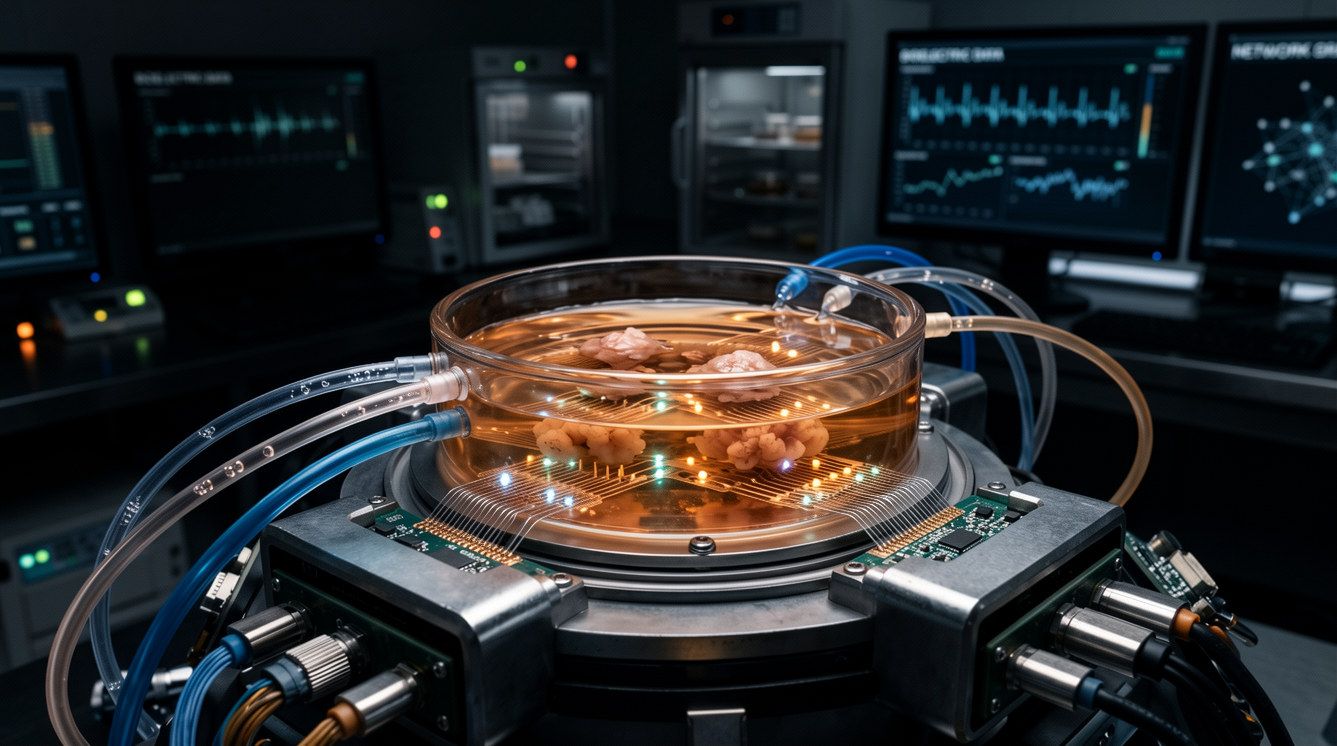
Instead of etching billions of microscopic transistors onto silicon wafers to artificially mimic neural synapses, bioengineers are now wiring actual living human brain organoids directly onto electronic microelectrode arrays to run computational tasks. These biological processors—living clusters of cellular tissue—are opening a completely unmapped frontier known as Organoid Intelligence (OI).
What Is Wetware Computing?
The term "hardware" refers to physical circuitry, while "software" designates the code executed across it. "Wetware" represents the biological substrate itself: living cellular networks that process signals electrochemically.
In modern biocomputing labs, scientists culture human pluripotent stem cells in specialized incubators, guiding their cellular differentiation into three-dimensional neural clusters termed "brain organoids." While these millimeter-sized clusters contain zero consciousness or cognitive awareness, they spontaneously develop working neural architectures, firing electrical impulses, creating dendritic branches, and forming synaptic connections.
To convert these living spheres into bioprocessors, researchers place them atop Multi-Electrode Arrays (MEAs):
- Input Channels: Microscopic pins deliver precise electrical stimulations to specific neuron clusters, translating digital data into bioelectric signals.
- Neural Processing: The living neurons adapt their synaptic weights in real time through biological plasticity, reorganizing connections organically rather than calculating mathematical matrix multiplications across silicon gates.
- Output Decoding: Surrounding electrodes capture the aggregate action potentials firing back from the tissue, which software decodes back into digital outputs.
Silicon vs. Biological Neural Networks: The Efficiency Divide
The core catalyst accelerating wetware research is an extraordinary thermodynamic disparity. The adult human brain operates approximately 86 billion interconnected neurons on a power budget of roughly 20 watts—barely enough energy to illuminate a dim household bulb. In contrast, running a comparable scale of artificial neural networks across silicon clusters demands hundreds of thousands of watts and continuous liquid cooling loops.
| Metric | Silicon GPU / TPU Accelerators | Biological Organoid Wetware |
|---|---|---|
| Base Substrate | Photolithographic silicon transistors | Cultured human neural cell clusters |
| Typical Power Draw | 300W to 1,000W per individual chip | Fraction of a milliwatt (excluding support life-support pumps) |
| Learning Mechanism | Algorithmic backpropagation via brute-force math | Natural synaptic plasticity (structural dendrite growth) |
| Operational Lifespan | 3 to 7+ years of continuous uptime | Weeks to several months (governed by biological decay) |
| Operational State | Dry electronic circuitry | Continuous perfusion in heated, oxygenated nutrient broth |
Overcoming the Perfusion Problem: Keeping Chips Alive
Unlike silicon motherboards, which can be powered off and shelved indefinitely, living biocomputers require active metabolic support. Without continuous nutrient delivery and waste filtration, neural tissues perish within hours.
To overcome biological fragility, specialized biocomputing platforms utilize automated microfluidic perfusion loops. Tiny peristaltic pumps continuously wash the organoids with sterile physiological solutions maintained strictly at 37°C. Modern culture designs have extended functional operating lifespans from a few days to over one hundred days, enabling longitudinal data capture and remote cloud-based access for outside academic researchers.
The Ethical and Technical Frontiers
While the field promises radical breakthroughs in energy efficiency, unsupervised machine learning, and neurodegenerative disease modeling, it inevitably introduces profound philosophical and practical questions:
- The Consciousness Boundary: Current organoids contain a few million neurons—drastically smaller than the brain of a common fruit fly or zebrafish—and exhibit no higher-order organization. Nonetheless, international bioethicists are establishing oversight frameworks to monitor whether scaling tissue clusters could eventually develop basic sensory response states.
- Determinism vs. Biological Chaos: Silicon chips are deterministic; running the exact same code on identical chips yields identical outputs. Biological tissue is inherently non-deterministic, varying across cell cultures. Training biological algorithms requires adapting to organic variability rather than demanding rigid mathematical predictability.
- Longevity and Standardization: Industrial manufacturing requires uniform tolerances. Scaling biological computers from research bench curiosities into commercial data centers will require reliable automated bioprinting and mass cell preservation techniques.
What Lies Ahead
Wetware computing is not poised to replace consumer silicon processors or everyday cloud workloads in the near future. Instead, it offers an experimental testbed for understanding how biological intelligence achieves massive learning feats without planetary-scale electricity consumption. As researchers continue bridging living cells with microelectronics, the line separating artificial systems from biological architecture continues to blur.
Related articles