
The Mystery of 'Dark Oxygen': How Strange Metallic Rocks in the Deep Pacific Make Oxygen Without Sunlight
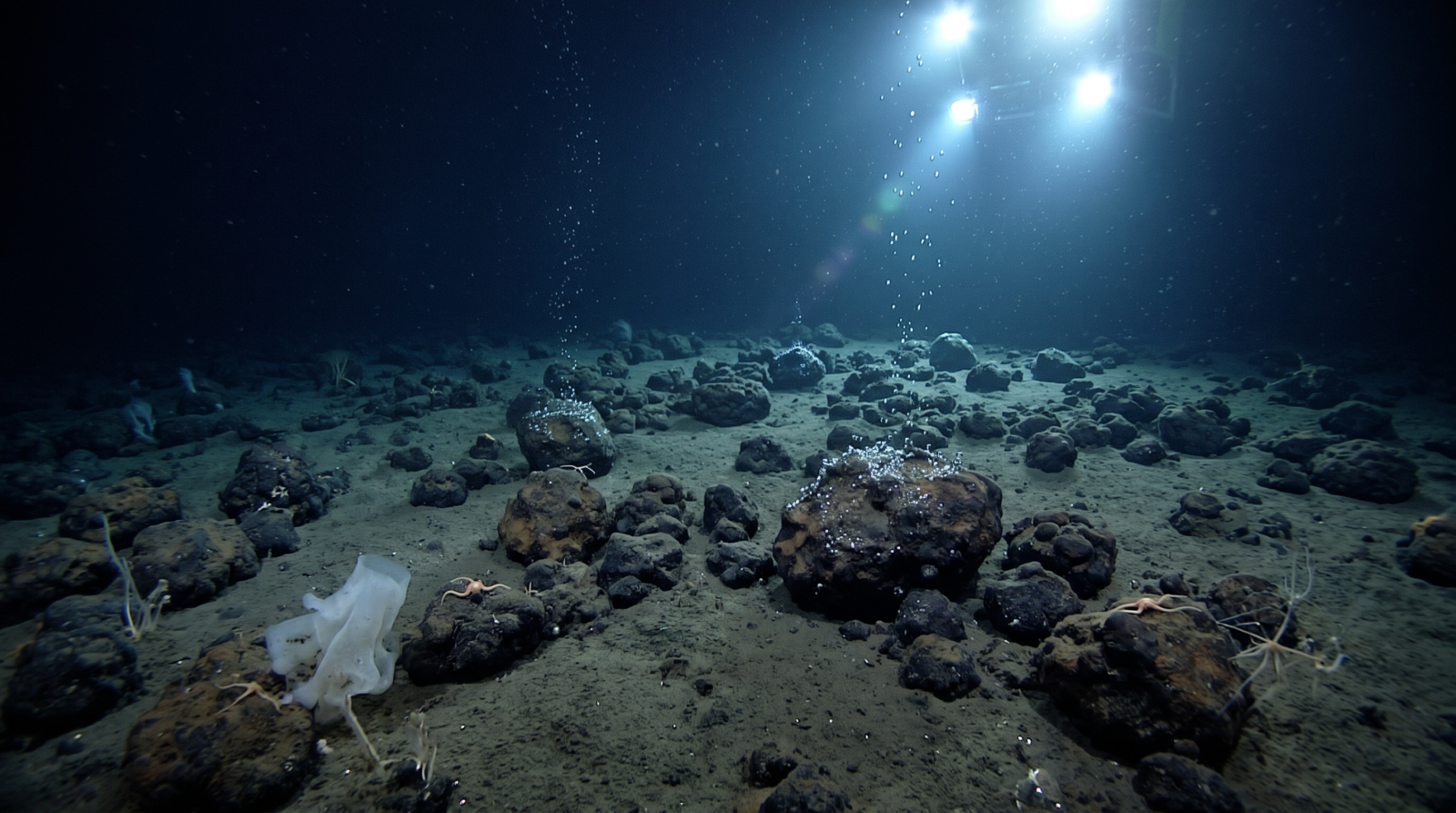
In July 2024, a research team reported something that sounded almost impossible: oxygen building up on the deep seafloor, in complete darkness, with no plants or algae nearby. The study, published in the journal Nature Geoscience and led by marine ecologist Andrew Sweetman, points to metallic lumps called polymetallic nodules as the possible source. The idea is still being tested, but it has already changed the conversation about life in the deep sea and about plans to mine it.
Quick Summary
- Where: The Clarion-Clipperton Zone (CCZ), an abyssal plain in the Pacific about 4,000 meters (13,000 feet) deep.
- What was seen: Oxygen levels rose inside sealed seafloor chambers, where scientists expected them to fall.
- Suspected source: Potato-sized metal-rich nodules, possibly acting like natural batteries.
- Status: Promising but debated. Other scientists have asked whether the readings could come from measurement problems, and the mechanism is not yet confirmed.
What the Researchers Found
The Clarion-Clipperton Zone stretches roughly 4,500 kilometers (about 2,800 miles) across the central Pacific between Hawaii and Mexico. At this depth there is no sunlight at all, the water is close to freezing, and the pressure is around 400 times that at the surface.
The team lowered sealed observation chambers, called benthic landers, onto the seafloor to measure how much oxygen the sediment and animals use up. Normally, oxygen inside such chambers drops over time because deep-sea life consumes it. Instead, the team recorded oxygen rising over several days.
That result is so unexpected that the researchers checked for ordinary explanations first, including sensor problems and biological activity. Their conclusion was that the oxygen appeared to be produced by a non-biological process linked to the nodules on the seabed.
How Could Rocks Make Oxygen?
Polymetallic nodules form very slowly, layer by layer, over millions of years. They are rich in manganese, nickel, cobalt and copper, which are the same metals used in electric vehicle batteries.
Splitting seawater into hydrogen and oxygen (H2O to H2 and O2) takes an electrical potential of roughly 1.5 volts. The researchers measured up to about 0.95 volts on the surface of individual nodules. Their hypothesis is that nodules touching each other could add up, much like cells stacked in a battery, and reach the voltage needed. This is a proposed explanation that scientists are still working to confirm.
| Feature | Photosynthesis | Proposed "Dark Oxygen" |
|---|---|---|
| Energy source | Sunlight | Electrical potential on mineral surfaces |
| Where it happens | Sunlit upper ocean and land (roughly the top 200 meters in the sea) | Deep abyssal plains, 3,500 to 5,500+ meters |
| Process | Biological (chlorophyll) | Non-biological (seawater electrolysis) |
| Living organisms needed | Plants, algae, phytoplankton | None proposed |
Why Some Scientists Are Not Convinced
A claim this big gets tested hard. Some researchers have questioned whether the oxygen readings could be an artifact of how the chambers and sensors were used, and they point out that the voltage seen on single nodules is below what electrolysis needs. Supporters of the finding say the repeated measurements and tests make a simple error unlikely. Until independent teams reproduce the result, "dark oxygen" is best described as a strong lead, not settled science.
Why It Matters for Deep-Sea Mining
The CCZ is often described as holding more nickel, cobalt and manganese than known land reserves combined, which makes it a major target for companies seeking battery metals. Mining proponents say collecting loose nodules from a flat seabed does less damage than digging mines on land.
If nodules really do help supply oxygen to the seafloor, removing them could affect the animals that live there, such as sea cucumbers, glass sponges, worms and single-celled xenophyophores. This is one reason conservation groups and some governments are calling for a pause on seabed mining until more is known.
What It Could Mean for the Origin of Life
If oxygen can be made without sunlight, scientists may need to rethink where oxygen-using life could exist. Some researchers have speculated about this for early Earth and for ice-covered ocean worlds such as Europa and Enceladus, whose oceans lie beneath thick ice. These are open hypotheses, not findings, and nothing in the 2024 study shows life on other worlds.
The Factora Take
The most useful way to read this story is as an open scientific question with real-world stakes. The discovery does not erase photosynthesis, which still produces the vast majority of the oxygen we breathe. What it does show is that the deep sea still holds surprises, and that decisions about mining it should wait for better evidence.
Frequently Asked Questions
What is dark oxygen?
Dark oxygen is oxygen that appears to be produced in total darkness on the deep seafloor, without photosynthesis.
Who discovered it?
A team led by Andrew Sweetman reported it in Nature Geoscience in July 2024.
Does this replace photosynthesis?
No. Photosynthesis remains the main source of the oxygen in our atmosphere. Dark oxygen is a possible small, local source on the deep seabed.
Is the finding proven?
Not yet. It is widely discussed, but other scientists are still checking the methods and the proposed explanation.
Related articles