Spain's Housing Strike Explained: Rents, Decrees and the 29 November Vote
On 11 November 2026, Spain held its first general strike in 14 years, with unions saying four million workers joined a 24-hour walkout over soaring rents and evictions. The strike came less than three weeks before a snap national election on 29 November, and one day before caretaker lawmakers narrowly approved a package of housing measures that includes rent caps, a temporary eviction ban and limits on corporate purchases of homes. Supporters call the measures overdue protection for tenants. Opponents argue they will shrink the supply of rental homes and push prices higher. Spain's voters will now decide which approach wins.
Last updated: 12 November 2026. This is a fast-moving political story. Votes, polls and legal details can change before and after the 29 November election.
Key Takeaways
- The 24-hour strike on 11 November was the first general strike in Spain since 2012. The two largest unions, UGT and CCOO, called it with tenants' associations.
- Participation is disputed. Unions claim four million workers took part, while the main employers' group estimated fewer than 5%. Support was uneven and strongest in coastal regions.
- The Bank of Spain estimates the country is short of about 750,000 homes, a gap it says could pass one million by 2028.
- Parliament rejected two emergency housing decrees on 2 October. That defeat led Prime Minister Pedro Sánchez to call the 29 November election.
- On 12 November, a 69-member caretaker body approved one decree by a single vote and rejected a second, on automatic lease renewals, also by one vote.
- The conservative Popular Party (PP) says it would repeal the measures and the 2023 Housing Law, and replace them with a plan to build one million homes.
What Happened on 11 November
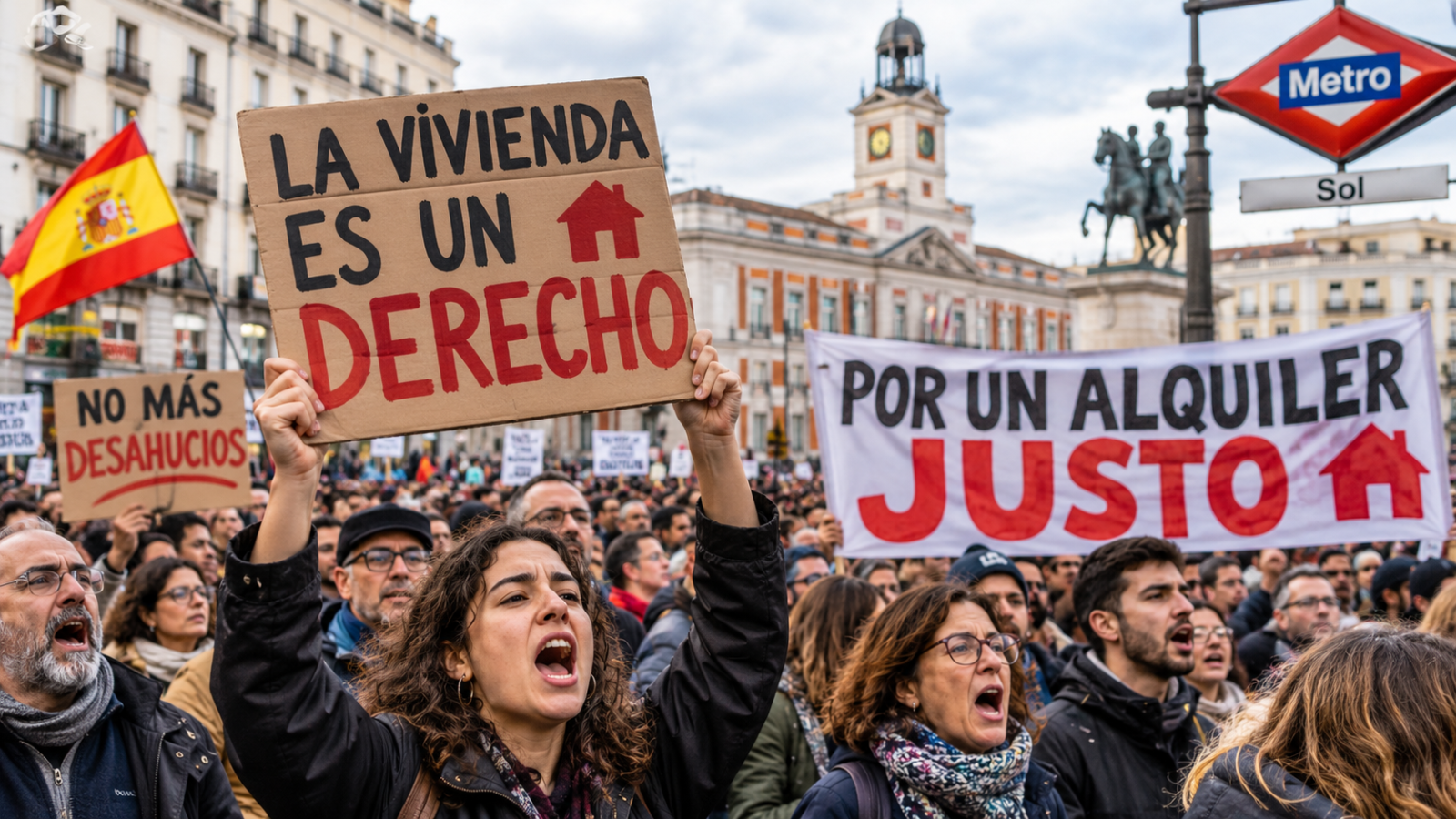
Spanish workers walked out for 24 hours under the slogan "wages, housing, prices". Public transport was disrupted, businesses closed in several cities, and tens of thousands marched in Madrid, Barcelona and elsewhere. There were confrontations with police in some places. The last time the two big unions called a general strike together was in 2012, during the austerity years of the euro crisis.
The numbers are contested, as in most strikes. The unions say four million people took part. Spain's main employers' confederation, CEOE, estimated that fewer than 5% of workers joined. Reports described uneven participation, with the strongest support in coastal regions where housing pressure is most severe. A vice-president of the employers' group argued that the strike was counterproductive because small businesses also suffer from the housing shortage, which makes hiring harder.
The politics around the strike are tangled. A senior PP figure called it an "election strike", and the PP leader, Alberto Núñez Feijóo, described it as a strike against the opposition. The far-right party Vox called it a campaign for Sánchez. The government defended the constitutional right to strike, and a UGT leader said housing costs were rising so fast that no salary could keep up. Readers should treat each of these as a political position, not a neutral assessment.
How One Eviction Became a National Crisis
The current wave of protest grew after the televised eviction of an 87-year-old woman in Madrid, Maricarmen Abascal, who died about two weeks later. Housing activists used the case to argue that evictions of vulnerable people were out of control. It sparked a protest camp in Madrid's Puerta del Sol and demonstrations in other cities, and it drew in the large unions that eventually called the general strike. No official finding has linked her death to any single cause, and the story is best understood as the spark rather than the cause of a much older problem.
The Numbers Behind the Anger
| Indicator | Reported figure |
|---|---|
| Housing shortfall (Bank of Spain) | About 750,000 homes, possibly more than 1 million by 2028 |
| Rents, 2015 to 2025 | Up about 87%, according to figures cited in reporting |
| Wages over the same period | Up around 30%, per the same figures |
| Rental burden (2024 Bank of Spain data) | Nearly 40% of renters spend about 40% of income on rent and utilities, versus an EU average of 27% |
| Public rental housing (2024 report) | Under 2% of homes, versus an OECD average of 7% |
Our arithmetic: if rents rose 87% while wages rose about 30%, rents grew nearly three times as fast as pay (87 divided by 30 is about 2.9). A shortfall rising from 750,000 to one million homes would be an increase of about one third. The rent and wage figures come from reporting rather than from a single official dataset, so they should be read as approximate.
What the Housing Decrees Do
Sánchez's minority government used emergency decree-laws, which take effect immediately but must be ratified by parliament. The package was approved by the government days before the 2 October vote in Congress.
- The first decree would have capped rent increases at 2%, barred evictions of vulnerable tenants, extended expiring leases and offered tax incentives to landlords who rent at regulated prices. It failed 178 to 172.
- The second decree, separated so it would not drag down the rest, dealt with automatic renewal of rental contracts.
- Other reported elements included limits on purchases of homes by companies and a requirement that an owner ending a contract compensate the tenant with a year's rent.
The vote turned on seven lawmakers from the Catalan party Junts, who had supported the government on other matters. Junts argued the decrees would push owners to withdraw homes from the rental market and make prices worse. The housing minister, Isabel Rodríguez, told the chamber her ministry had adopted 90% of Junts' proposals. The PP, Vox and a small regional party also voted no.
Sánchez responded by dissolving parliament and calling an election for 29 November. His government then re-approved the decrees in largely the same form. They took effect temporarily once published in the official gazette, but needed approval from the 69 caretaker deputies who remain in place after dissolution, compared with 350 in a full parliament. On 12 November that body approved the main decree by one vote and rejected the lease-renewal decree by one vote.
Two Competing Visions
This debate is not only about left and right. It is a real disagreement about what makes housing affordable, and both sides cite sincere arguments.
The tenant-protection case. The government, unions and tenants' associations argue that speculation, investment funds and weak protections have turned homes into financial assets. They say rent caps and eviction limits are needed now, because building new housing takes years while people are being priced out today. Protesters carried signs saying housing is a right, not a business.
The supply case. The PP, Vox and Junts argue that controls reduce rental supply and discourage investment. A PP lawmaker said housing becomes more affordable by building more homes, not by decree. The PP manifesto promises about one million homes over the legislature, faster building licences, a reform of land rules, and changes that would let large flats be divided and extra floors be added to buildings. It would also repeal the 2023 Housing Law, including its "stressed area" and price-reference tools, and adopt a tougher anti-squatting law. Vox says the crisis stems from immigration and over-regulation rather than speculation, a claim its critics reject.
Economists broadly agree that Spain needs more homes, and that both short-term tenant protection and long-term construction matter. What they argue about is the balance, and how much rent limits reduce supply. International evidence on rent controls is mixed, so claims from either camp that the question is settled should be treated with caution.
What the PP's Plan Would Mean in Practice
One million homes over a four-year term works out to roughly 250,000 a year. That is larger than the Bank of Spain's estimated current shortfall, but new households keep forming, so the plan's effect would depend on how many homes are built and how fast. Critics question whether regional governments, which control much planning, could deliver such numbers. Supporters point to the aim of cutting red tape and releasing public land. Neither claim can be tested until construction actually begins.
What Happens Next
| Date | Milestone |
|---|---|
| 2 October | Congress rejects both housing decrees. |
| 11 November | General strike over housing, wages and prices. |
| 12 November | Caretaker body approves the main decree by one vote. |
| 29 November | Snap general election. Polls reported by media put the PP ahead of Sánchez's Socialists. |
| After the vote | Government formation talks. A PP-led government has said it would repeal the measures. |
If the PP wins and forms a government, the measures passed on 12 November could be repealed, so tenants and landlords face real uncertainty. Spanish politics is fragmented, so even the leading party may need support from smaller groups, and government formation after the 2023 vote took nearly four months.
Practical Steps if You Are Affected
- Tenants: read your lease end date and check whether your region has its own rules. Keep copies of rent receipts and any landlord notices.
- Landlords and investors: track the election result and any repeal plans, since rules on caps and corporate purchases may change.
- Expats and renters planning a move: ask about lease length and how rent updates are calculated before signing.
- Travellers: check transport strike notices on official operator websites if you are visiting around dates of further action.
- Everyone: rely on official sources such as the housing ministry, the electoral authorities and regional governments for current rules.
Why This Matters Beyond Spain
Spain is not alone. Housing costs outrunning pay have become a political issue in many countries, and the arguments heard in Madrid, rent limits versus new construction, echo debates elsewhere. If you follow affordability at home, see our explainers on US mortgage rates after the Fed's rate hike and on home loan EMIs after the RBI rate hike. The Spanish case is a useful live test of how a country balances tenants, landlords and builders under political pressure.
The Factora Take
Spain's housing dispute is a rare case where a policy argument has gone all the way to the streets and the ballot box within weeks. The facts are not in dispute: there are too few homes, and rents have outrun pay. What voters must decide is how to respond. Tenant protections offer relief quickly but may reduce supply, while building more homes helps over the long run but offers little to someone facing eviction this month. A credible answer probably needs both, which makes the real test of the 29 November result not who wins, but whether the winner can deliver homes and stability together. Watch for specific numbers on construction, not slogans.
This article is for general information only. It is not legal, tax or financial advice. Tenancy and property rules vary by region and change often, so consult a qualified professional before making decisions.
Frequently Asked Questions
Why did Spain hold a general strike on 11 November?
The UGT and CCOO unions, backed by tenants' associations, called a 24-hour strike over high rents, evictions, wages and prices. It was Spain's first general strike since 2012.
How many people took part?
Unions say four million. The main employers' group estimated fewer than 5% of workers. Participation was uneven across the country.
What are the housing decrees?
They are emergency measures by Sánchez's government that include rent caps, a temporary eviction ban and limits on corporate purchases of homes. On 12 November, caretaker lawmakers approved the main decree by one vote.
Why is there an election on 29 November?
After parliament rejected the housing decrees on 2 October, Sánchez dissolved parliament and called an early election.
What would the PP do on housing?
The PP says it would repeal the 2023 Housing Law and the new measures, and aim to build one million homes over the legislature by easing planning rules and releasing land.
Related articles